
Table of Contents
Introduction
Samsung’s display names can be confusing. Super AMOLED, Dynamic AMOLED, and Dynamic AMOLED 2X sound like completely different technologies, but they’re all part of the same AMOLED family.
The basic technology is similar: each pixel produces its own light, so there’s no separate backlight like you’d find in an LCD.
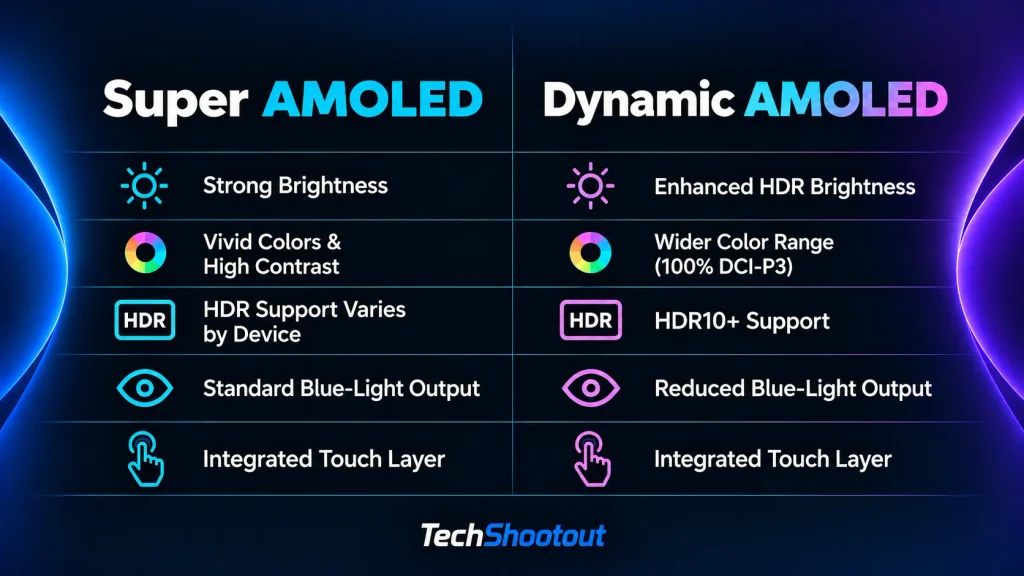
The real Dynamic AMOLED vs Super AMOLED difference comes down to how Samsung has improved and branded newer generations of its displays. Dynamic AMOLED is the newer designation, bringing features such as HDR10+ certification and reduced blue-light emission.
That doesn’t automatically make every Dynamic AMOLED screen better. Brightness, refresh rate, resolution, calibration, and the quality of the panel itself still matter. So, what actually separates the two?
Dynamic AMOLED vs Super AMOLED at a Glance
| Feature | Super AMOLED | Dynamic AMOLED |
|---|---|---|
| Display family | AMOLED/OLED | AMOLED/OLED |
| Individual pixels emit light | Yes | Yes |
| Separate backlight | No | No |
| Touch layer | Integrated into display | Integrated into display |
| Deep blacks | Yes | Yes |
| HDR support | Depends on device | Introduced with HDR10+ certification |
| Color performance | Depends on panel and calibration | Wide color; depends on calibration |
| Blue-light reduction | Depends on panel/device | Reduced blue-light output emphasized |
| Refresh rate | Depends on device | Depends on device |
| Power consumption | Content-dependent | Content-dependent |
| Typical use | Used across many Galaxy devices | Common on newer premium Galaxy devices |
The table makes Dynamic AMOLED look like a straightforward upgrade, but some of these differences need context.
What Is Super AMOLED?
Super AMOLED is Samsung’s name for an AMOLED display that integrates the touch-sensitive layer into the screen rather than placing it as a separate layer on top.
Like other AMOLED displays, it doesn’t need a separate backlight. Each pixel produces its own light and can effectively switch off when displaying black, giving Super AMOLED screens their deep blacks and high contrast.
The integrated design also allowed Samsung to make thinner displays, and Super AMOLED eventually became a familiar feature across many Galaxy phones.
But the name doesn’t tell you everything about the screen. Two Super AMOLED phones can have very different brightness, resolution, refresh rate, color tuning, and HDR capabilities. That’s worth keeping in mind when comparing Super AMOLED with Dynamic AMOLED.
If you want a closer look at where Super AMOLED fits into Samsung’s display lineup, our AMOLED vs Super AMOLED comparison explains the differences in more detail.
What Is Dynamic AMOLED?
Dynamic AMOLED is a newer Samsung display designation built on the same basic AMOLED technology as Super AMOLED. You still get self-emissive pixels, deep blacks, high contrast, and no separate backlight.
Samsung introduced the Dynamic AMOLED name with the Galaxy S10 series, highlighting improvements such as HDR10+ certification, strong color performance, and reduced blue-light emission.
HDR10+ allows compatible content to adjust HDR information from scene to scene, rather than using the same settings for the entire video.
So, what is the difference between Dynamic AMOLED and Super AMOLED? It’s not the same kind of comparison as OLED versus LCD. Dynamic AMOLED is better thought of as a newer evolution of Samsung’s AMOLED displays, with additional features and certifications layered on top.
Dynamic AMOLED vs Super AMOLED: What Actually Changes?
The differences become clearer when we stop looking at the branding and examine what you’ll actually see on a phone.
1. Both Have Excellent Black Levels
There’s little difference here. Both Super AMOLED and Dynamic AMOLED use self-emissive pixels that can switch off when displaying black.
That gives both excellent black levels and contrast, especially compared with backlit LCD screens. Our OLED vs LCD comparison goes deeper into why the two display technologies handle blacks, brightness, battery use, and burn-in differently.
Moving from Super AMOLED to Dynamic AMOLED doesn’t fundamentally change this advantage.
2. Dynamic AMOLED Puts More Emphasis on HDR
HDR is a more meaningful difference.
Samsung introduced Dynamic AMOLED with HDR10+ certification, putting a greater emphasis on HDR content. On a capable display, HDR can produce brighter highlights while preserving detail across bright and dark parts of an image.
But the Dynamic AMOLED name alone doesn’t guarantee better HDR. Peak brightness, tone mapping, panel quality, software, and the content you’re watching all play a role.
A newer Dynamic AMOLED flagship will often outperform an older Super AMOLED phone in HDR, but some of that advantage also comes from newer display hardware.
3. Color Depends on More Than the Display Name
Both Super AMOLED and Dynamic AMOLED can produce excellent color.
Older AMOLED screens were often known for their punchy, saturated appearance, while newer Samsung displays have become more refined. Display modes and calibration can also make a noticeable difference between phones.
So, don’t assume Dynamic AMOLED simply means more colorful. More saturated isn’t the same as more accurate. When comparing two phones, the quality and calibration of the individual panels matter more than the AMOLED label alone.
4. Dynamic AMOLED Reduces Blue-Light Output
Samsung also introduced Dynamic AMOLED with an emphasis on reducing blue-light emission. The idea is to reduce some blue-light output at the panel level without relying entirely on the warmer, yellow tint used by software-based eye-comfort modes.
That doesn’t mean Dynamic AMOLED produces no blue light or guarantees less eye strain or better sleep. Brightness, viewing time, ambient lighting, and your nighttime habits still matter.
It’s better to think of reduced blue-light output as one improvement to the display rather than a complete solution for eye comfort.
Is Dynamic AMOLED Brighter Than Super AMOLED?
Not necessarily.
Newer Dynamic AMOLED flagships can reach very high brightness levels, but that doesn’t mean Dynamic AMOLED is inherently brighter than Super AMOLED.
Brightness is panel-specific. A Super AMOLED screen can be brighter than a Dynamic AMOLED screen depending on the device, panel, and generation.
Modern Samsung displays are generally much brighter than older Galaxy screens, but that’s also the result of years of display improvements, not simply the Dynamic AMOLED name.
When comparing two phones, look at their actual measured or rated brightness rather than the AMOLED branding.
Does Dynamic AMOLED Use Less Battery?
Again, there isn’t a simple winner.
Both are AMOLED displays, so power consumption depends partly on what’s on the screen. Dark interfaces can use less power because OLED pixels reduce their light output or switch off when displaying black, while bright content generally requires more power.
We saw this effect in our own Dark Mode battery test on an OLED iPhone 15, although the size of the saving depended on what was displayed and how the phone was being used.
But battery life depends on much more than the display type. Brightness, refresh rate, resolution, panel efficiency, screen size, and the rest of the phone’s hardware all matter.
So, a Dynamic AMOLED phone won’t automatically last longer than a Super AMOLED phone. You need to compare the actual devices.
Refresh rate is a good example. A 60Hz and 120Hz display can have different power demands, which brings us to another common misconception.
Does Dynamic AMOLED Mean 120Hz?
No. Dynamic AMOLED doesn’t automatically mean 120Hz.
It’s easy to connect the two because many newer Samsung flagships have both, but they’re separate specifications. Dynamic AMOLED describes the display, while refresh rate tells you how often the screen can update each second.
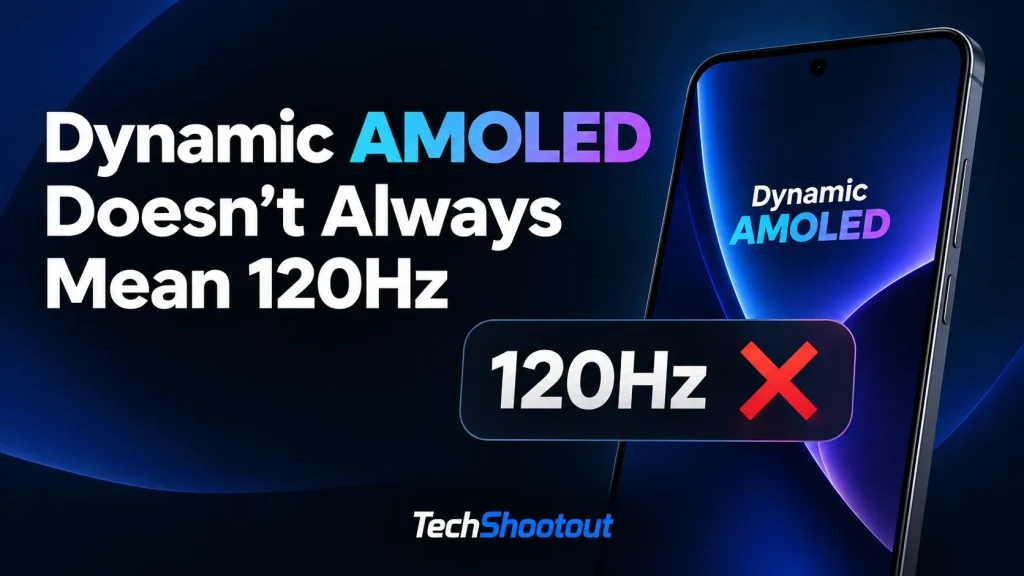
In fact, Samsung’s earlier Dynamic AMOLED phones didn’t necessarily come with the high refresh rates we now expect from premium Galaxy models. Higher and adaptive refresh rates became more common later, especially with Dynamic AMOLED 2X displays.
So if refresh rate matters to you, check the phone itself rather than relying on the Dynamic AMOLED name.
Dynamic AMOLED 2X vs Super AMOLED: What Changes?
This is where Samsung’s naming gets a little more confusing. Dynamic AMOLED 2X is a newer display name used on many premium Galaxy phones. You’ll often see it paired with features such as high or adaptive refresh rates, strong brightness, and HDR support.
But don’t take the “2X” too literally. It doesn’t mean the screen is simply twice as good as Super AMOLED.
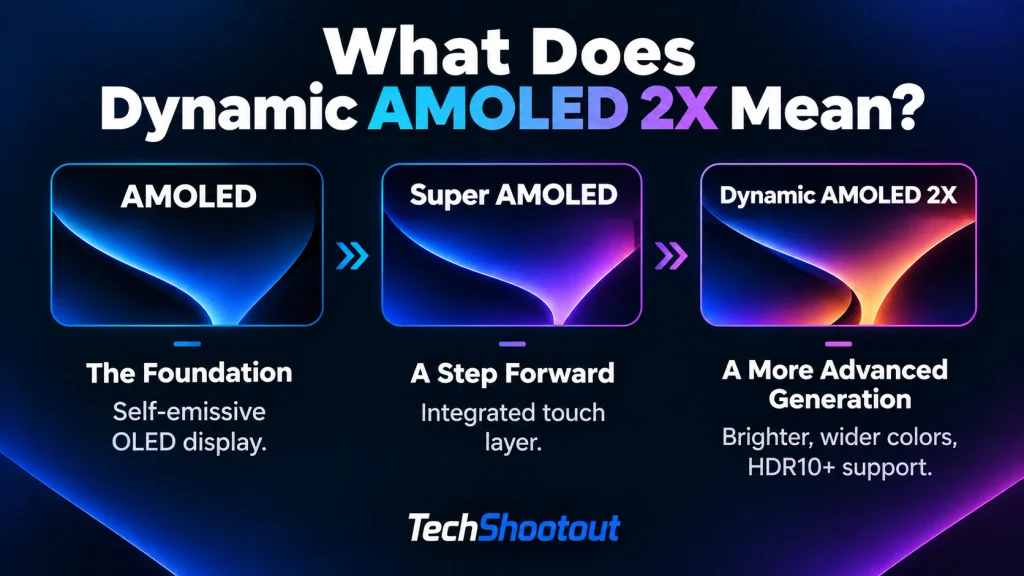
A modern Dynamic AMOLED 2X flagship will usually have a much more capable display than an older Super AMOLED phone, but that’s largely because the underlying panel and hardware have improved over the years.
So, when comparing Dynamic AMOLED 2X vs Super AMOLED, look beyond the name. Refresh rate, brightness, resolution, HDR support, color accuracy, and efficiency will tell you much more about the actual display.
Super AMOLED vs Dynamic AMOLED for Watching Videos
When comparing Super AMOLED vs Dynamic AMOLED for watching videos, Dynamic AMOLED generally has the edge, especially with HDR content on a newer Galaxy phone.
Its stronger focus on HDR10+ and newer panel technology can make compatible movies and shows look more impressive. But don’t expect a huge difference with everything you watch.
Play a regular SDR YouTube video on two good Samsung phones, for example, and a Super AMOLED screen can still look excellent. Both technologies deliver the deep blacks and strong contrast that make OLED displays ideal for video.
The difference becomes more noticeable when the content can actually take advantage of the newer display’s HDR capabilities.
Which Is Better for Gaming?
For gaming, don’t choose a phone just because it says Dynamic AMOLED instead of Super AMOLED. Refresh rate matters much more. A 120Hz Dynamic AMOLED screen can feel noticeably smoother than an older 60Hz Super AMOLED display, especially in games that can actually run at higher frame rates.
But that’s largely a refresh-rate advantage, not something Dynamic AMOLED automatically provides.
Brightness, touch responsiveness, resolution, and battery life matter too. And the display is only half the story. A great-looking 120Hz screen won’t help much if the processor struggles to keep the game running smoothly or the phone heats up and reduces performance. For gaming, look at the whole phone rather than the AMOLED label.
What About Burn-In?
Both displays are based on OLED technology, so burn-in is still possible. OLED pixels gradually age as they’re used. If the same static elements stay on-screen for long periods over months or years, some pixels can age faster than others, potentially leaving a permanent visible pattern. Status icons, navigation controls, and other fixed interface elements are common examples.
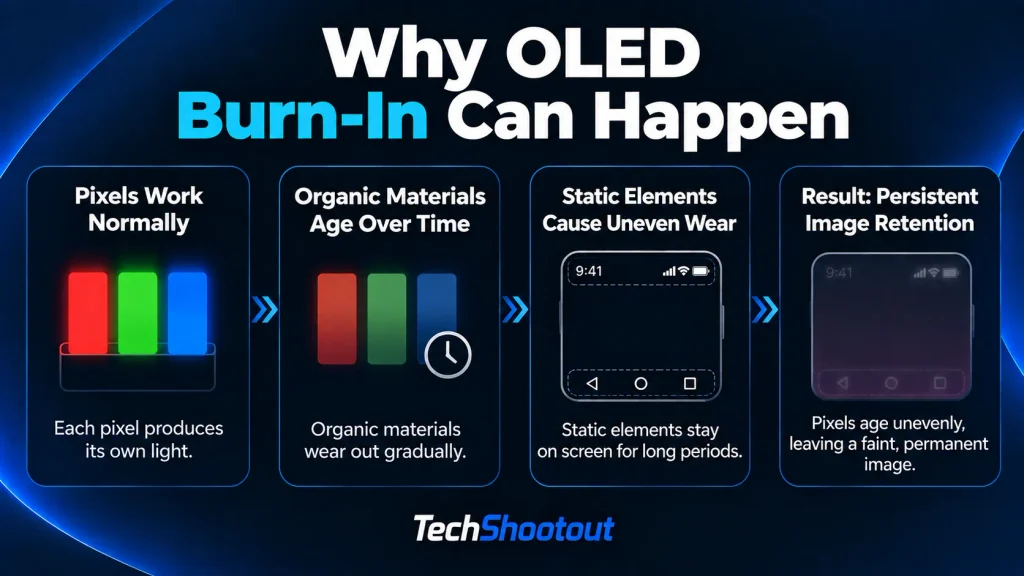
Modern phones use several techniques to reduce the risk, so burn-in isn’t something most people need to worry about during normal everyday use. However, Dynamic AMOLED doesn’t eliminate the underlying aging characteristics of OLED.
If you plan to keep your phone for several years, simple habits can help. Avoid leaving static images on-screen for unnecessarily long periods, and don’t keep the display at maximum brightness when you don’t need it.
Can You Actually See the Difference?
Sometimes, but probably not in the way the names suggest. Put an older Super AMOLED Galaxy next to a recent Dynamic AMOLED flagship and, yes, the newer phone will probably look noticeably better.
It may be brighter outdoors, smoother when scrolling, better at displaying HDR content, and more accurately tuned. But that doesn’t mean all of those improvements come from switching from “Super AMOLED” to “Dynamic AMOLED.”
A lot has changed between those generations. Samsung has improved its panels, brightness, refresh rates, display processing, calibration, and other parts of the technology along the way.
Compare two phones from roughly the same generation, and the difference may be much less obvious. That’s why I wouldn’t choose a phone based on the display branding alone. The actual screen quality and specifications matter far more than whether Samsung calls it Super AMOLED or Dynamic AMOLED.
Which Is Better, Dynamic AMOLED or Super AMOLED?
If you’re wondering which is better, Dynamic AMOLED or Super AMOLED, Dynamic AMOLED is generally the more advanced of Samsung’s two display families. Samsung introduced Dynamic AMOLED on its newer premium Galaxy phones, with features such as HDR10+ certification, a wide color range, and reduced blue-light output.
That doesn’t suddenly make Super AMOLED a bad display, though. A good Super AMOLED screen still gives you most of what makes OLED attractive in the first place: deep blacks, excellent contrast, vibrant colors, a thin design, and good efficiency in the right conditions.
And the name on the spec sheet only tells you so much.
Two phones carrying different AMOLED labels can still be surprisingly close in everyday use. Brightness, refresh rate, resolution, color tuning, HDR performance, and the age of the panel can matter more than whether Samsung calls the screen Super AMOLED or Dynamic AMOLED.
So is Dynamic AMOLED better than Super AMOLED? In general, yes. It represents a newer stage in Samsung’s AMOLED display development and is usually found in its more advanced displays. But when you’re choosing between two phones, compare the screens themselves, not just the names Samsung gives them.
Final Verdict
The Dynamic AMOLED vs Super AMOLED comparison sounds like a bigger difference than it really is. Both are part of Samsung’s AMOLED display family, and both use self-emissive OLED pixels. That means you get the familiar OLED advantages, including deep blacks, excellent contrast, and no traditional LCD backlight.
Dynamic AMOLED came later, bringing more emphasis on features such as HDR10+, color performance, and reduced blue-light output. Samsung has since moved on to Dynamic AMOLED 2X for many of its premium Galaxy phones, often pairing these displays with high refresh rates and other improvements.
But if you’re buying a phone, I wouldn’t worry too much about the name.
A Dynamic AMOLED badge doesn’t automatically mean one phone has a better screen than another phone using Super AMOLED. Check the actual brightness, refresh rate, resolution, HDR performance, color accuracy, and how the display performs in real-world use.
The name gives you an idea of where the screen sits in Samsung’s AMOLED lineup. What ultimately matters is how good that particular display actually is.
FAQs
What is the difference between Dynamic AMOLED and Super AMOLED?
The main difference between Dynamic AMOLED and Super AMOLED is that Dynamic AMOLED represents a newer generation of Samsung’s AMOLED display family. Both use self-emissive OLED pixels and deliver deep blacks and high contrast, but Samsung introduced Dynamic AMOLED with greater emphasis on features such as HDR10+ certification, wide color reproduction, and reduced blue-light emission.
Which is better, Dynamic AMOLED or Super AMOLED?
If you’re wondering which is better, Dynamic AMOLED or Super AMOLED, Dynamic AMOLED generally represents the newer and more advanced Samsung display family. However, the name alone doesn’t determine display quality. Brightness, resolution, refresh rate, calibration, HDR performance, and the specific panel used in the phone matter more when comparing two actual devices.
Is Dynamic AMOLED better than Super AMOLED?
Generally, yes, but not in every possible comparison. Dynamic AMOLED is better than Super AMOLED as a newer stage in Samsung’s premium AMOLED development, particularly in areas such as HDR capabilities and newer panel implementations. However, a Dynamic AMOLED label doesn’t automatically mean a display is brighter, smoother, or more power-efficient than every Super AMOLED screen.
Is Dynamic AMOLED 2X better than Super AMOLED?
Dynamic AMOLED 2X is used in many newer premium Samsung phones and often comes with features such as high refresh rates. A recent Dynamic AMOLED 2X display will usually be better than an older Super AMOLED screen, but the actual brightness, resolution, and refresh rate matter more than the name alone.
Does Dynamic AMOLED save more battery than Super AMOLED?
Not automatically. Both are AMOLED-based technologies, so power consumption changes with screen brightness, displayed content, panel efficiency, resolution, and refresh rate. Dark content can reduce display power consumption because OLED pixels produce their own light, but you can’t assume a Dynamic AMOLED phone will have better battery life simply because of its display branding.