
Table of Contents
Introduction
OLED has become one of the most desirable display technologies in modern smartphones, laptops, tablets, and TVs. Look through the specifications of a premium phone today, and there is a good chance you will find some form of OLED panel. LCD, meanwhile, is increasingly associated with affordable devices.
That makes OLED vs LCD sound like an easy comparison. OLED is newer, so surely OLED is better. In many areas, it is.
OLED can produce genuinely black pixels, extremely high contrast, excellent viewing angles, and the kind of deep, high-contrast image that immediately stands out besides a conventional LCD. It has also enabled thinner phones, curved screens, and modern foldable devices.
But the difference isn’t as simple as OLED is good and LCD is bad.
A high-quality LCD can still produce accurate colors, strong brightness, sharp text, and an excellent everyday viewing experience. OLED also has its disadvantages, including burn-in and variable power consumption depending on what’s displayed.
The main difference is how OLED and LCD produce light. Once you understand that, most of the differences between the two make sense.
OLED vs LCD: The Quick Answer
For most people buying a premium smartphone today, OLED is the better display technology.
Its ability to control light at the individual-pixel level gives it a clear advantage in black levels and contrast. Dark scenes look better, blacks can appear truly black, and the display doesn’t need a separate backlight.
LCD still has its strengths. It doesn’t have the same burn-in risk as OLED, and a good IPS LCD can deliver excellent brightness, sharpness, and color accuracy. LCD can also help manufacturers keep device costs down.
Here’s the basic difference:
| Feature | OLED | LCD |
|---|---|---|
| Light source | Individual pixels emit light | Separate backlight |
| Black levels | Excellent; pixels can switch off | Blacks can appear slightly illuminated |
| Contrast | Excellent | Lower than OLED |
| Viewing angles | Usually excellent | Good on quality IPS panels |
| Dark-mode efficiency | Can reduce power use | Much smaller benefit |
| Burn-in risk | Possible | No OLED-style burn-in |
| Flexible/foldable designs | Well suited | Much more difficult |
| Cost | Generally higher | Generally lower |
| Overall choice | Better for most premium devices | Good for budget and value devices |
But don’t choose a phone based on the words OLED or LCD alone. A great LCD can still be better than a poorly implemented OLED.
What Is an OLED Display?
OLED stands for Organic Light-Emitting Diode. The most important part isn’t the name. It’s what happens at the pixel level. An OLED display doesn’t need a conventional backlight behind the screen. Its pixels produce their own light.
Imagine a completely black image on an OLED screen. The pixels responsible for displaying black can simply switch off. They aren’t trying to block light coming from somewhere behind them. The result is true black. Now place a small white object in the middle of that black screen. Only the pixels needed to produce that object have to light up.
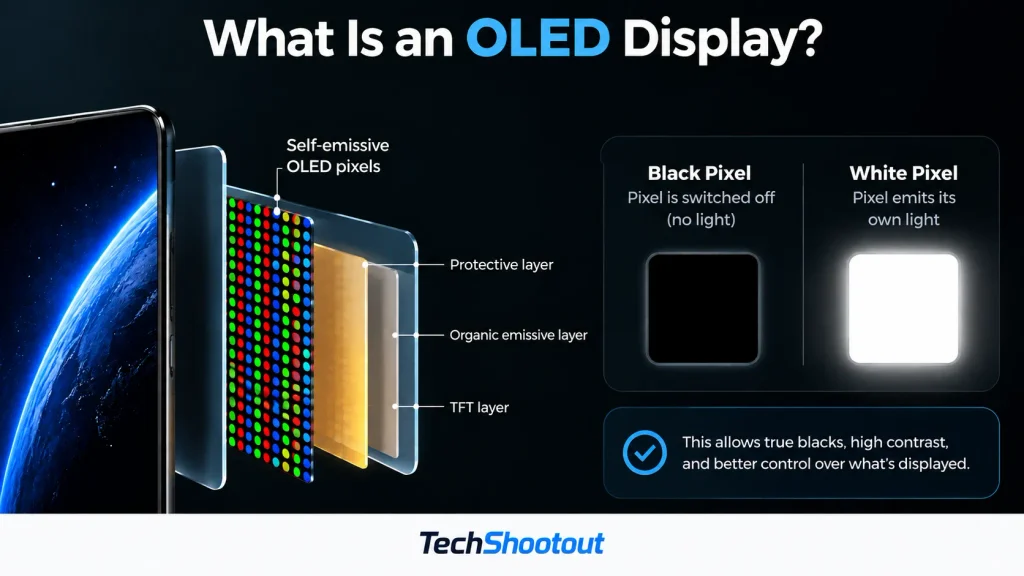
This pixel-level light control is the foundation of many of OLED’s advantages. It’s why OLED screens can produce extremely deep blacks. It’s why their contrast is so impressive. It’s also why displaying dark content can sometimes consume less power.
Most OLED displays used in modern smartphones are active-matrix displays, which is where the familiar term AMOLED comes from. So when you see OLED, AMOLED, Super AMOLED, Dynamic AMOLED, or P-OLED on smartphone specification sheets, you’re looking at technologies belonging to the broader OLED family, even though their construction, branding, and capabilities can differ.
If you want to explore the OLED family further, our OLED vs AMOLED and AMOLED vs Super AMOLED comparisons explain how these closely related display technologies differ.
What Is an LCD Display?
LCD stands for Liquid Crystal Display. Unlike OLED, LCD pixels don’t produce their own light. Instead, the display relies on a backlight that shines through layers of liquid crystals, polarizers, and color filters to create the image you see.
This works well, but it also leads to one of LCD’s biggest limitations. The backlight remains active even when parts of the image are supposed to be black. The display can block much of that light, but not as precisely as OLED can by switching individual pixels off. As a result, blacks can sometimes appear slightly gray, especially in a dark room.
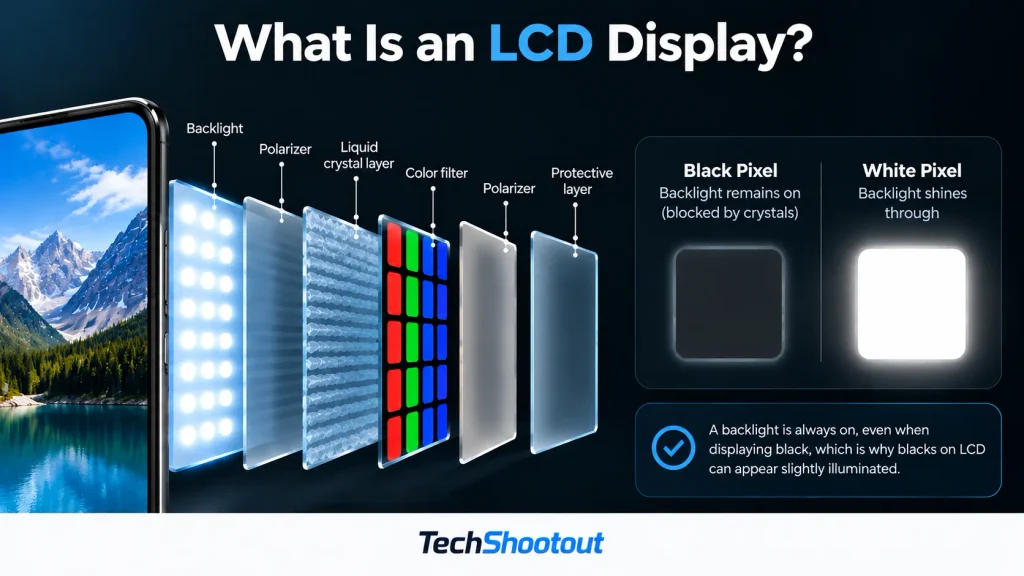
Modern LCDs have improved considerably. IPS LCD, in particular, offers excellent viewing angles and color performance and became widely used across smartphones, tablets, laptops, and monitors. So LCD shouldn’t automatically be interpreted as a poor display. Panel quality still matters enormously.
OLED vs LCD Display Quality
Put a good OLED and a good LCD next to each other, and the first difference you’re likely to notice is contrast.
OLED tends to look more dramatic. In a scene with bright objects against a dark background, black pixels can remain completely dark while the brighter parts of the image still stand out. LCDs have to produce the same scene using its backlight, so blacks generally won’t look as deep.
The difference is particularly noticeable when watching movies in a dark room or using a dark interface at night. But contrast isn’t everything. Resolution, brightness, color calibration, refresh rate, pixel density, reflectivity, viewing angles, and software tuning all affect how good a display actually looks.
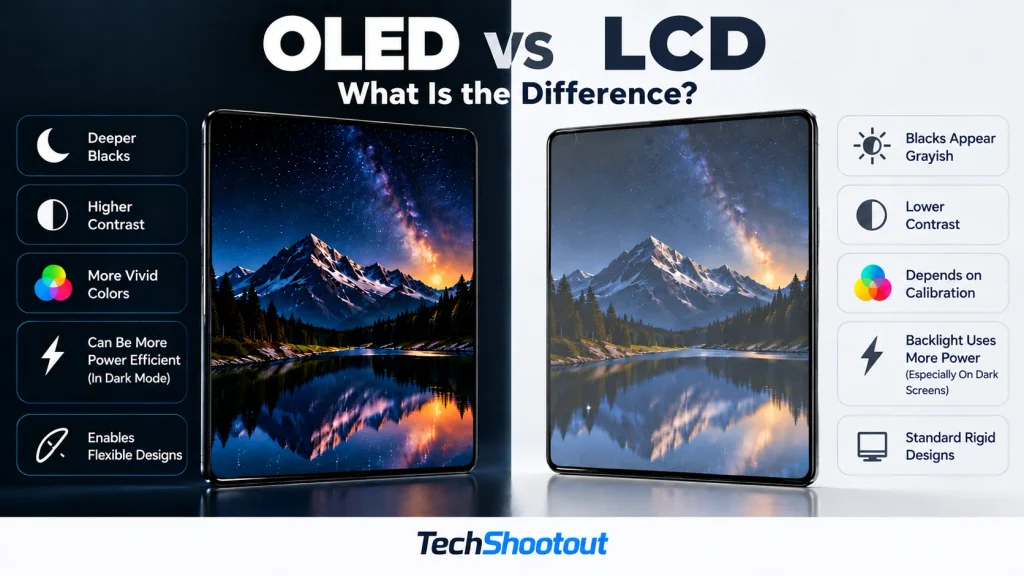
That’s why saying “OLED always looks better than LCD” goes too far. A poorly calibrated OLED doesn’t automatically become a great display because its pixels are self-emissive. Likewise, a high-quality IPS LCD can still look excellent.
OLED vs LCD Screen: Which Has Better Blacks and Contrast?
This is the easiest category to call. OLED wins.
Because individual OLED pixels can switch off, black areas can appear truly black while bright parts of the image remain bright. LCD relies on a backlight, so some light can still come through areas that are supposed to be completely dark.
You might barely notice the difference while reading a webpage outdoors. Watch a dark movie at night, however, and it can become obvious. It’s one of OLED’s clearest advantages over LCD and a major reason the technology became so popular in premium devices.
Which Has Better Colors?
This one is more complicated.
OLED displays have a reputation for vibrant, saturated colors, partly because earlier AMOLED phones often used aggressive display modes that made everything look extremely punchy.
But vivid doesn’t necessarily mean accurate.
Modern OLED displays can be calibrated extremely well, and so can high-quality LCDs. Two OLED phones can look surprisingly different simply because of their calibration and display settings.
So don’t assume an OLED phone has better color accuracy just because it’s OLED. Panel quality and calibration matter more than the label on the specification sheet.
OLED vs LCD for Brightness and Outdoor Use
You might expect OLED to win brightness as easily as it wins contrast, but this depends heavily on the individual display.
Modern premium OLED panels can get extremely bright, particularly in small highlighted areas and outdoor high-brightness modes. LCDs can also reach high brightness levels thanks to powerful backlighting.
But brightness alone doesn’t determine outdoor visibility. Reflection handling, sustained brightness, and how the phone responds to direct sunlight all make a difference. A bright screen with poor reflection control can still be difficult to see outdoors.
So if outdoor visibility matters to you, tested brightness and reflectivity are more useful than panel type alone.
OLED vs LCD: Which Has Better Viewing Angles?
OLED generally has the advantage here. Colors and contrast tend to remain more consistent when you look at an OLED screen from an angle, although a good IPS LCD can still offer very respectable viewing angles.
On a smartphone, the difference may not matter much because you’re usually looking directly at the screen. It becomes more noticeable when several people are viewing the same display or when you’re looking at a larger screen from an off-center position.
OLED vs LCD Battery Life
This is one of the most misunderstood parts of the comparison. You’ve probably heard that OLED uses less battery than LCD.
Sometimes it does. But not always.
OLED power consumption depends partly on what’s being displayed. A mostly dark interface can use less power because black pixels can switch off, while a bright white screen requires far more pixels to produce light. Research from Purdue University found that the power savings from dark mode on OLED smartphones vary considerably with screen brightness.
LCD works differently because its backlight remains active regardless of whether the screen is showing a light or dark interface.
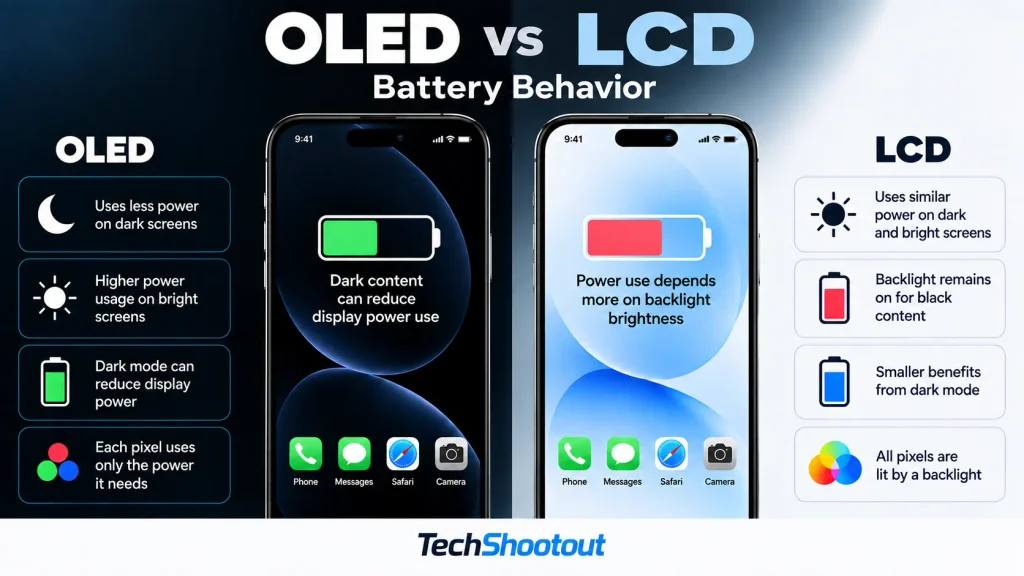
But that doesn’t mean every OLED phone will have better battery life than an LCD phone. Display size, brightness, refresh rate, resolution, battery capacity, processor efficiency, software, and network conditions all play a role. Our iPhone Dark Mode battery test also shows why real-world testing is more useful than judging battery efficiency by display technology alone.
OLED Burn-In vs LCD
OLED’s biggest long-term concern is burn-in.
OLED pixels use organic materials that gradually age with use. If the same static elements, such as navigation buttons, status icons, or game interfaces, remain on screen repeatedly for long periods, some pixels can age differently from others. This OLED burn-in can eventually leave a faint permanent pattern on the display.
This is different from temporary image retention. True burn-in is permanent. Modern smartphones use several techniques to reduce the risk, and many users may never experience noticeable burn-in during the life of their phone. Still, the possibility remains.
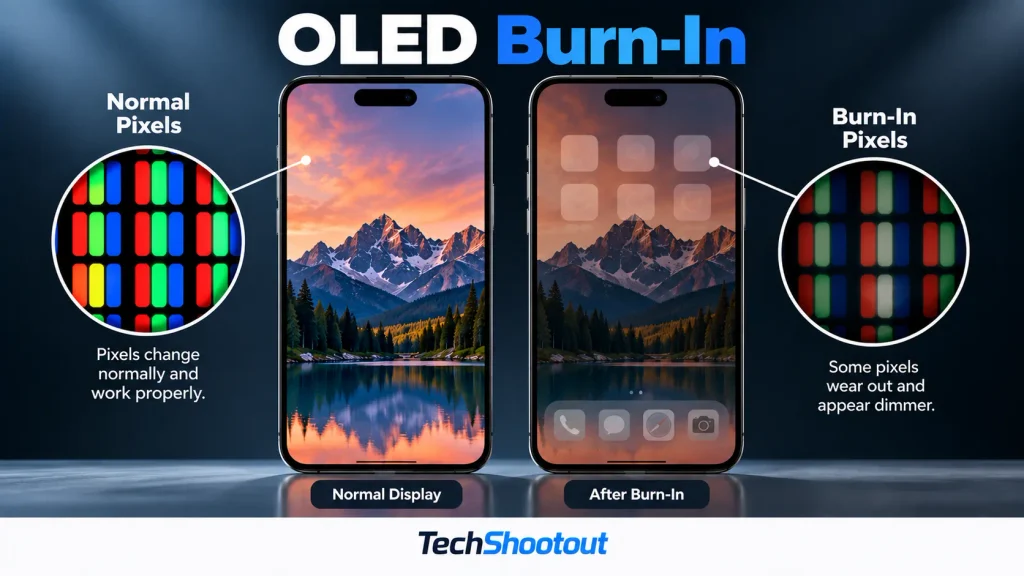
LCD doesn’t suffer from OLED burn-in in the same way, which can make it better suited to situations where static content stays on screen for long periods.
For most smartphone users, though, burn-in is best viewed as a potential OLED disadvantage rather than a reason to avoid OLED completely.
Which Is Better for Gaming?
OLED has some genuine advantages for gaming. Pixel response times are typically very fast, contrast is excellent, and modern OLED panels can support high refresh rates.
But the OLED label doesn’t tell you everything.
A 120Hz OLED will usually feel much smoother than a 60Hz LCD, but much of that difference comes from the higher refresh rate. A good high-refresh-rate LCD can also deliver a very smooth gaming experience.
For gaming, refresh rate, pixel response time, touch response, brightness, resolution, and the performance of the device itself all matter.
So while OLED generally has the edge for gaming, the specifications of the actual display matter more than the technology name alone.
Why OLED Is Used in Foldable Phones
Foldable phones highlight one advantage of OLED that LCD has difficulty matching.
OLED panels can be built on flexible substrates without the separate backlight structure used by LCD, making them much better suited to screens that need to bend. That’s why modern foldable phones rely heavily on OLED technology.
The same flexibility has also made curved screens and thinner display assemblies possible.
LCD remains perfectly suitable for conventional flat screens, but OLED gives manufacturers more flexibility when designing unusual form factors.
Is LCD Easier on the Eyes?
You may see claims that LCD is always better for your eyes or that OLED is inherently more comfortable. It’s not that simple.
Some OLED displays use pulse-width modulation, or PWM, to control brightness by rapidly varying light output. Some people report eye strain, headaches, or discomfort with displays that have noticeable flicker, although sensitivity varies considerably from person to person and between devices.
LCD isn’t automatically flicker-free either.
If you’re sensitive to screen flicker, check flicker measurements for the specific device you’re considering rather than choosing based on OLED or LCD alone.
OLED or LCD: Which Lasts Longer?
LCD has an advantage when it comes to long-term pixel aging because it doesn’t rely on the same organic light-emitting materials as OLED.
That doesn’t mean modern OLED screens have short lives. A high-quality OLED panel can remain perfectly usable for years, and modern display-management techniques help reduce the effects of uneven aging.
For normal smartphone use, I wouldn’t choose LCD solely because it may last longer on paper. The difference matters more in situations where a display runs for very long periods, particularly with static content.
For most phone buyers, both technologies should comfortably handle several years of normal use.
Is a Cheap OLED Better Than a Good LCD?
Not necessarily. This is an important distinction in the OLED vs LCD debate. Display technology tells you how a panel works, but it doesn’t tell you how good that particular panel is.
Imagine an inexpensive OLED with mediocre brightness, poor calibration, noticeable flicker, and a 60Hz refresh rate. Now compare it with a high-quality IPS LCD offering strong brightness, accurate colors, and a 120Hz refresh rate.
Calling the OLED automatically better would ignore much of what actually affects the viewing experience. So when comparing real products, look beyond the OLED or LCD label and consider the quality of the display itself.
OLED vs LCD: Which Is Better for Smartphones?
If everything else were reasonably equal, we would choose OLED.
The black levels and contrast advantage is real, and it is something you can actually see rather than a specification that exists only on paper. OLED also works particularly well with dark interfaces and gives manufacturers more freedom to build thinner, curved, and foldable devices.
That’s why OLED has become so common in premium smartphones.
But LCD still makes sense.
A good LCD phone can offer excellent image quality while keeping the device affordable, and some users may prefer LCD because they’re concerned about OLED flicker or long-term burn-in.
The mistake is judging an entire phone by one word on its specification sheet.
OLED vs LCD: Final Verdict
After comparing the two technologies, OLED is the better overall choice for most modern smartphones and premium consumer devices. Its deep blacks, excellent contrast, strong viewing angles, and design flexibility give it advantages that LCD struggles to match.
But LCD is far from obsolete. A good LCD can still be bright, sharp, color-accurate, and excellent to use, often in a more affordable device.
So if you’re deciding between OLED or LCD, treat the panel technology as a starting point, not the final verdict.
Between two otherwise comparable high-quality screens, we’d take OLED. Between two actual phones, we’d compare the displays themselves. A great screen is defined by far more than the letters printed on the specification sheet.
FAQs
Is OLED better than LCD?
For most premium consumer devices, OLED has clear advantages over LCD, including deeper blacks, higher contrast, excellent viewing angles, and greater design flexibility. But panel quality still matters, and a good LCD can be better than a mediocre OLED.
What is the main difference between OLED and LCD?
The main difference between OLED and LCD is how they produce light. OLED pixels emit their own light and can switch off individually, while LCD pixels don’t produce light themselves and instead use light from a separate backlight.
Does OLED use less battery than LCD?
Not always. OLED can be very efficient when displaying dark content because black pixels can switch off. But brighter content requires more pixels to produce light, so power consumption varies depending on what’s displayed. Overall battery life depends on many factors beyond display technology.
Does OLED suffer from burn-in?
Yes. OLED displays can develop burn-in because their organic light-emitting materials gradually age. Modern devices use techniques to reduce the risk, though, and many users never experience noticeable burn-in during normal ownership.
Is LCD better than OLED for long-term use?
LCD doesn’t have the same burn-in risk as OLED, which can make it a better choice for screens that display static content for long periods. For normal smartphone use, though, there’s little reason to avoid a modern OLED simply because of lifespan concerns.
Which is better, OLED or LCD, for phones?
OLED is generally the better choice when comparing otherwise similar high-quality smartphone displays. Its deeper blacks, excellent contrast, wide viewing angles, and thinner construction give it some clear advantages. But the OLED label doesn’t tell you everything. Brightness, refresh rate, resolution, color accuracy, flicker, and efficiency also matter when choosing a phone.
Is OLED better than LCD for eyes?
Neither technology is automatically better for everyone. Some OLED displays use PWM to control brightness, which may bother sensitive users, while LCD displays can also flicker depending on their backlight design. The specific screen’s flicker behavior, brightness, and viewing conditions matter more than whether it is OLED or LCD.