
Introduction
Scroll through phone spec sheets and you’ll see OLED on one and AMOLED on another. It’s easy to assume AMOLED is the newer or more advanced technology, but the two aren’t really competitors.
AMOLED is actually a type of OLED. Both use pixels that produce their own light instead of relying on a separate backlight like an LCD. The main difference is how those pixels are controlled.
That difference matters, but it doesn’t tell you which phone has the better screen. Brightness, color accuracy, refresh rate, resolution, and overall panel quality can matter much more than the OLED or AMOLED label.
So rather than treating OLED vs AMOLED as a battle between two rival technologies, it’s more useful to understand how they’re related and what actually makes one phone display better than another.
In this guide, we’ll explain the difference between OLED and AMOLED, where that difference matters, and what to look for when comparing phone displays.
Contents
OLED vs AMOLED: Quick Comparison
Here’s a brief overview before we get into the details.
| Feature | OLED | AMOLED |
|---|---|---|
| Full name | Organic Light-Emitting Diode | Active-Matrix Organic Light-Emitting Diode |
| Backlight required | No | No |
| Self-lighting pixels | Yes | Yes |
| True blacks | Yes | Yes |
| High contrast | Yes | Yes |
| Active-matrix control | Used in modern phone OLEDs | Yes, by definition |
| High refresh rates | Available | Available |
| Burn-in possible | Yes | Yes |
| Power efficiency | Depends on panel and content | Depends on panel and content |
| Common in smartphones | Yes | Yes |
AMOLED sits inside the OLED family; it isn’t a separate technology altogether. That makes AMOLED vs OLED a very different comparison from something like OLED vs LCD, where the two actually produce light in fundamentally different ways.
What Is OLED?
OLED stands for Organic Light-Emitting Diode. The easiest way to understand it is to compare it with an LCD. An LCD uses a separate backlight behind the screen, while the pixels control how much of that light passes through.
OLED works differently. Each pixel produces its own light, so when part of an image needs to be black, those pixels can simply turn off. That’s why blacks on a high-quality OLED screen look genuinely black rather than dark grey, especially in a dim room.
This also gives OLED its strong contrast. A bright pixel can sit right next to one that’s completely off. OLED panels can also be thin, offer fast response times, and give manufacturers more flexibility when designing phones, tablets, and TVs.
But OLED is a broad term. It doesn’t tell you how good a particular screen will look or perform. That’s where AMOLED comes in.
What Is AMOLED?
AMOLED stands for Active-Matrix Organic Light-Emitting Diode. It still uses OLED’s self-lighting pixels, but an active-matrix backplane uses thin-film transistors (TFTs) to control each pixel.
This setup is well suited to the high-resolution, high-refresh-rate screens used in modern phones because it can control a large number of pixels quickly and precisely.
The name can make AMOLED sound like an upgrade over OLED, but that’s not really the case. OLED is the broader display technology, while AMOLED is a type of OLED.
That’s why seeing “AMOLED” on one phone and “OLED” on another doesn’t tell you which screen is better. You still need to look at the quality and performance of the actual display.
What’s the Difference Between OLED and AMOLED?
On a technical level, the difference between AMOLED and OLED is mostly about how the pixels are driven. AMOLED uses an active-matrix backplane to control them, but that distinction is less useful than it sounds when you’re comparing modern phones.
Modern smartphone OLED panels use active-matrix driving because passive-matrix OLED is better suited to smaller, lower-resolution displays. That’s why OLED vs AMOLED can become confusing on phone spec sheets. One brand may simply call its screen OLED while another emphasizes AMOLED, even though the label alone tells you very little about overall display quality.

Don’t assume the phone advertised as AMOLED automatically has the better screen. A phone labeled simply as OLED can still have the better display if its panel offers stronger brightness, better color accuracy, smarter refresh-rate control, and better overall tuning.
Why Do Some Phones Use OLED While Others Use AMOLED?
Phone makers aren’t always consistent with the names they use for OLED displays. One may simply list a screen as OLED, while another calls it AMOLED or uses its own branded name.
That can make the differences sound bigger than they really are. Two phones may use closely related OLED technology but describe it very differently on their spec sheets.
So don’t treat OLED and AMOLED labels as a ranking. They tell you something about the type of display, but they don’t tell you which screen is actually better.
Does OLED or AMOLED Have Better Display Quality?
OLED-based displays are known for many of the qualities people associate with premium phone screens. Deep blacks and strong contrast can make dark movie scenes more convincing and give photos, games, and interface elements a more striking look. Viewing angles are generally strong too, although that still varies from one panel to another.
The more significant differences appear when you compare individual phone displays. Two OLED-based screens can look noticeably different even when they share the same basic display technology. Resolution and pixel density affect sharpness, while panel materials and design can influence brightness and power efficiency. Calibration affects how colors are rendered, and HDR performance plays a role in how convincingly bright highlights and darker details are reproduced. Even flagship OLED panels can differ noticeably.
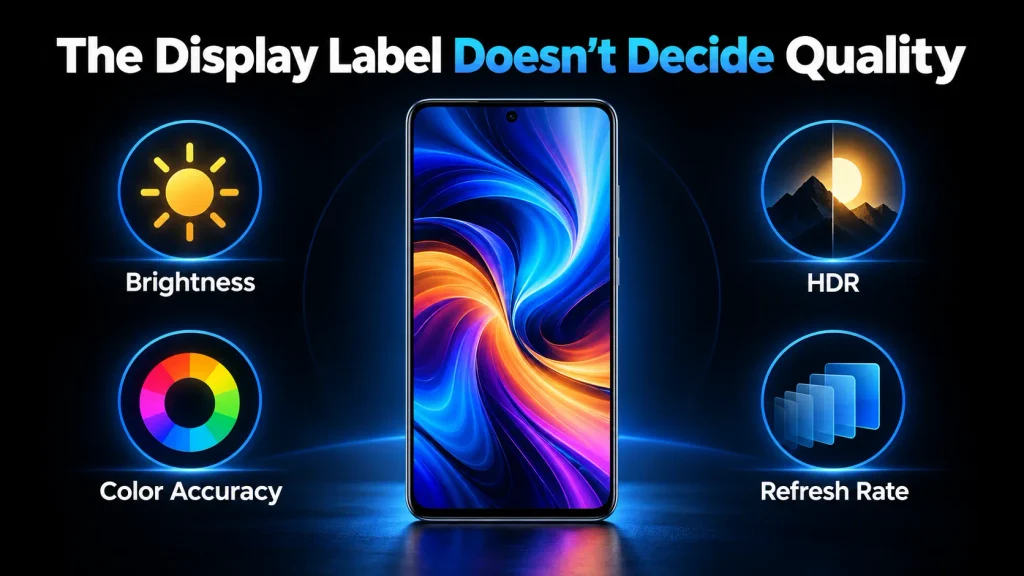
So OLED vs AMOLED display quality can’t be judged by name alone. The individual panel is responsible for the majority of the work.
You can see how those differences play out between two major smartphone brands in our iPhone vs Samsung comparison, which also compares their displays, performance, cameras, battery life, and software.
Which Looks Better Outdoors?
Brightness is one of the first differences you’ll notice in everyday use. A screen can look great indoors but become much harder to see in direct sunlight. If you often check maps, read messages, or take photos outside, real-world brightness matters more than the headline number on a spec sheet.
There’s no rule that AMOLED beats OLED here. Brightness depends on the specific panel and how the phone manages it. A good OLED screen can get very bright regardless of whether the manufacturer calls it OLED or AMOLED.
The same goes for color. OLED displays can produce vivid colors, but how those colors actually look depends heavily on calibration and the display mode you choose. Some phones favor a punchier, more saturated look, while others aim for more accurate colors. Many also give you a choice between different color modes.
Outdoor visibility isn’t just about peak brightness either. How long the screen can stay bright, how much light it reflects, and when maximum brightness becomes available all affect how easy it is to see outside.
If you’re comparing two phones, independent display measurements and reliable hands-on reviews will tell you much more about outdoor visibility than the OLED or AMOLED label.
OLED vs AMOLED Battery Consumption
OLED screens have an interesting relationship with power because every pixel produces its own light. When you’re looking at mostly black content, many of those pixels can simply turn off and use very little power. That’s why dark mode can save battery on OLED phones, although how much you’ll actually save depends on screen brightness, the content you’re viewing, and how you use your phone.
Comparing OLED and AMOLED for battery life isn’t straightforward. An AMOLED label doesn’t automatically mean the screen uses less power. Actual power consumption depends on the efficiency of the panel, brightness, refresh rate, resolution, and what’s being displayed.
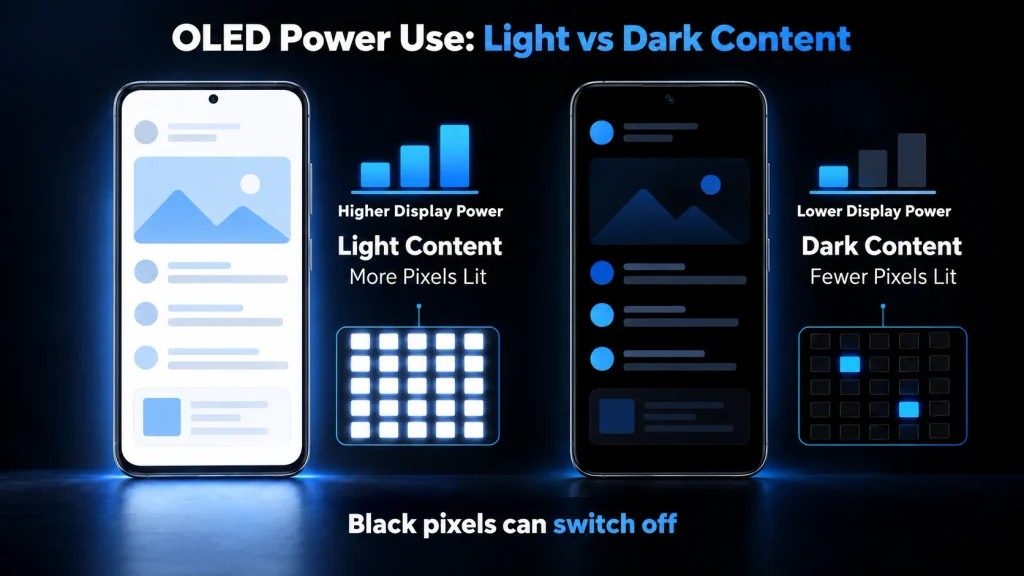
Display technology is only one part of overall phone efficiency. Our iPhone vs Samsung battery life comparison looks more closely at how displays, processors, battery capacity, and software optimization affect real-world battery life.
Brightness can make a particularly noticeable difference. The brighter the screen becomes, the more power it generally needs. Higher refresh rates can also increase power use, which is why many phones now use adaptive refresh rates. The display can drop to a lower refresh rate when the screen is mostly static and increase it again when smoother motion is useful.
If battery life matters to you, the phone’s overall display efficiency and power management are far more important than whether AMOLED appears on the spec sheet.
OLED vs AMOLED Refresh Rate
Higher refresh rates have made a noticeable difference to how modern phone displays feel. Jumping from 60Hz to 90Hz or 120Hz makes scrolling, animations, and supported games feel noticeably smoother.
AMOLED screens commonly offer high refresh rates, but the AMOLED name isn’t what makes this possible. Phones marketed simply as OLED can offer 90Hz, 120Hz, or higher refresh rates too. Adaptive refresh can also vary the rate based on what’s happening on screen.
OLED-based panels generally have fast pixel response times as well, which helps keep moving images sharp. What matters more is the refresh rate the phone actually supports and how consistently it uses it.
OLED vs AMOLED Durability and Burn-In
Burn-in is one of the biggest concerns people have about OLED screens. Since OLED and AMOLED both rely on organic materials, pixels age as they’re used. If the same static elements sit on screen for long stretches, those pixels can age differently from the ones around them.
Over time, that can leave faint ghost images of things like navigation bars or status icons. AMOLED isn’t exempt. It’s still built on OLED pixels underneath.
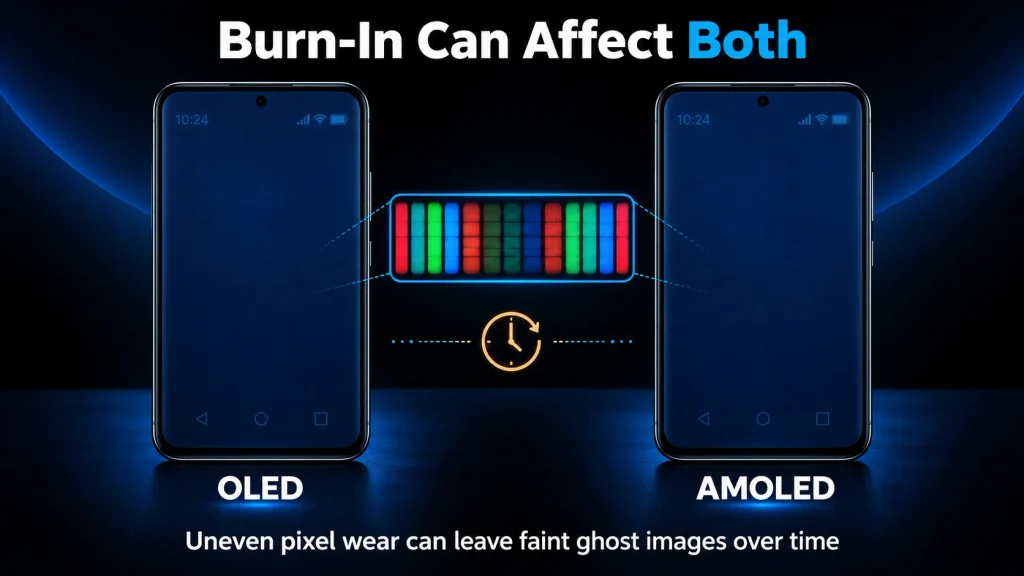
Modern phones use software tricks to reduce the risk, and normal use constantly changes what’s on screen. Messaging, browsing, watching videos, and switching apps are very different from leaving the same static image displayed for hours.
Your habits still matter. Leaving the same static image on screen at high brightness for hours is a lot harder on the panel than typical daily use.
Burn-in is worth knowing about, but it’s not a real reason to pick OLED over AMOLED or vice versa. Both share the same underlying risk.
Why Some OLED Screens Flicker at Low Brightness
One thing you won’t usually find on a spec sheet is how the screen handles brightness.
Many OLED phone displays use pulse-width modulation (PWM), which rapidly turns the pixels on and off to control how bright the screen appears. Most people won’t notice the flicker, but some are more sensitive to it, especially at lower brightness levels.
This isn’t really an OLED vs AMOLED issue. PWM frequency and dimming methods can vary between phones, even with the same display type.
If you’re sensitive to screen flicker, it’s worth checking PWM measurements for the specific phone you’re considering rather than judging it by the OLED or AMOLED label alone.
What About Super AMOLED, Dynamic AMOLED, and LTPO OLED?
The naming doesn’t stop at OLED and AMOLED. You’ll also come across terms like Super AMOLED, Dynamic AMOLED, Dynamic AMOLED 2X, P-OLED, and LTPO OLED. These aren’t all entirely different display technologies.
Some are brand names for a manufacturer’s version or generation of OLED, while others describe a particular part of the display or how it works. LTPO, for example, refers to the backplane technology and can help a screen adjust its refresh rate more efficiently. It’s still an OLED display underneath.
So don’t assume a fancier name automatically means a better screen. The actual panel quality and how it performs matter more than the label.
OLED vs AMOLED: Which Is Better?
So, OLED vs AMOLED: which one is better? For phones, you can’t really pick a winner based on the name alone.
AMOLED’s active-matrix design works well for the high-resolution, high-refresh-rate displays used in modern smartphones. But AMOLED is already a type of OLED, so comparing the two directly is a bit like asking whether a sedan is better than a car.
What really matters is the specific display you’re comparing.
Look at brightness, refresh rate, resolution, color accuracy, HDR performance, outdoor visibility, power efficiency, and, if you’re sensitive to screen flicker, PWM behavior.
A good OLED display can easily outperform a lower-quality AMOLED panel. At the same time, a high-end AMOLED screen can offer some of the best display quality you’ll find on a smartphone.
Final Verdict
OLED vs AMOLED becomes much easier to understand once you realize they aren’t two competing display technologies. OLED is the broader display family, while AMOLED is a type of OLED that uses an active-matrix system to control its pixels.
Both can give you the things you’d expect from a good phone screen: deep blacks, strong contrast, vibrant colors, fast response times, and a thin design.
The bigger differences show up from one phone to another. Panel quality, brightness, color tuning, refresh rate, and power efficiency matter far more than whether the spec sheet says OLED or AMOLED.
So if you’re comparing phones, don’t judge the screen by the display name alone. Look at how bright it gets, how well it handles color and refresh rate, how efficient it is, and how easy it is to see outdoors. Those details will tell you much more about the screen you’re actually getting.
FAQs
Is AMOLED better than OLED?
Not necessarily. AMOLED is a type of OLED that uses an active-matrix system to control its pixels. In modern smartphones, the quality of the individual panel matters much more than whether the manufacturer calls it OLED or AMOLED. Brightness, color accuracy, refresh rate, power efficiency, and display tuning are better things to compare.
What is the main difference between OLED and AMOLED?
The main difference is how the pixels are controlled. OLED is the broader display technology, while AMOLED uses an active-matrix backplane with thin-film transistors to control individual pixels. Most modern smartphone OLED displays already use active-matrix technology.
Which is better for phones, OLED or AMOLED?
Both can deliver excellent smartphone displays. AMOLED is widely used in modern phones, but an AMOLED label doesn’t guarantee better picture quality. A high-quality OLED screen can easily look and perform better than a lower-quality AMOLED panel.
Which uses more battery, OLED or AMOLED?
Neither is automatically more power-efficient. Both use self-lighting pixels, so battery use depends more on the specific panel, screen brightness, refresh rate, resolution, and what’s being displayed. Dark content can use less power because black pixels can switch off completely.
Do OLED and AMOLED screens suffer from burn-in?
Yes. Both OLED and AMOLED screens can develop burn-in because their pixels gradually age with use. The risk is higher when bright, static elements stay on screen for long periods.
Modern phones use several techniques to help reduce burn-in, and with normal, varied use, it’s generally less of a concern.
Is OLED or AMOLED better for your eyes?
Neither is automatically better for eye comfort. Some OLED and AMOLED displays use PWM to control brightness, and people who are sensitive to flicker may experience discomfort, particularly at lower brightness levels. PWM frequency and dimming behavior vary between individual phones, so the specific display matters more than the OLED or AMOLED name.