
Table of Contents
Introduction
Smartphone display names have become increasingly difficult to decode. AMOLED, Super AMOLED, Dynamic AMOLED, LTPO AMOLED, and several other labels can appear on specification sheets, often with little explanation of what actually changes from one screen to another.
AMOLED vs Super AMOLED sounds like a straightforward comparison, but there is an important detail to understand from the start: Super AMOLED is not an entirely different display technology. It is Samsung’s branding for an AMOLED implementation that, when introduced, integrated the touch-sensing layer more directly into the display rather than using a separate touch layer.
That distinction matters because the “Super” name alone doesn’t automatically tell you which phone has the better screen. A modern AMOLED panel with excellent brightness, efficient power management, and accurate colors can easily be a better display than an older phone carrying the Super AMOLED label.
So, rather than judging these displays by branding, let’s look at what AMOLED and Super AMOLED actually mean, where they differ, and which one makes more sense when buying a phone today.
What Is an AMOLED Display?
AMOLED stands for Active-Matrix Organic Light-Emitting Diode. The easiest way to understand AMOLED is to first understand how OLED displays differ from traditional LCDs. An LCD relies on a backlight to illuminate the display.
OLED pixels, on the other hand, generate their own light. That allows individual pixels to effectively switch off when displaying black. If you’re unfamiliar with the terminology, our OLED vs AMOLED comparison explains how the two technologies are related.
The result is the deep black levels and high contrast that OLED displays are known for. Put a bright object against a completely black background, and the difference from a conventional backlit LCD can be immediately noticeable.
The “AM” in AMOLED refers to the active-matrix system used to control the pixels. This allows individual pixels to be controlled quickly and precisely, making AMOLED well suited to the high-resolution, fast-changing images on modern smartphones.
AMOLED has several practical advantages:
- Very deep blacks
- High contrast
- Fast pixel response
- Wide viewing angles
- Thin display construction
- Potential power savings with darker content
- Excellent suitability for flexible and foldable screens
But AMOLED itself is a broad technology category.
Two phones can both advertise AMOLED displays while delivering noticeably different experiences. Resolution, peak brightness, refresh rate, color calibration, efficiency, panel generation, and the phone manufacturer’s tuning can all affect the final result. That’s an important point to remember throughout this comparison.
What Is a Super AMOLED Display?
Super AMOLED is Samsung’s branded implementation of AMOLED display technology. The major distinction historically associated with Super AMOLED is touch integration.
On conventional touchscreen designs, the touch-sensitive component can exist as an additional layer associated with the display assembly. Samsung developed touch-integrated OLED technology that embeds touch sensors directly into the panel rather than relying on a separate touch-screen film.
Samsung Display also uses the term OCTA (On-Cell Touch AMOLED) for its touch-integrated OLED technology. Samsung Display says it first developed its touch-integrated OLED technology for smartphones in 2010. By removing the separate touch film, the structure can become thinner and lighter while improving light transmission.
This is where the difference between AMOLED and Super AMOLED becomes much clearer.
Super AMOLED isn’t replacing OLED’s fundamental method of producing an image. The pixels remain self-emissive OLED pixels, controlled by an active matrix. Instead, Samsung improved how the touchscreen and display were integrated into the overall panel.
In other words:
Super AMOLED is AMOLED, but AMOLED is not always Super AMOLED. That simple distinction clears up much of the confusion surrounding the two names.
AMOLED vs Super AMOLED: Key Differences
If you look only at the names, you might expect a dramatic technological gap. In reality, the AMOLED vs Super AMOLED display comparison is more nuanced.
Here are the differences that actually matter.
Touch Integration and Thickness
This is the most important historical distinction. A traditional display assembly can use an additional touch-sensitive layer. Samsung’s touch-integrated OLED approach incorporates the touch sensors directly into the panel.
Removing an additional film simplifies the structure. Samsung Display says a conventional touch film can account for roughly 6% to 11% of total panel thickness in the applications it discussed when introducing larger OCTA panels. Integrating the touch sensor can therefore contribute to thinner and lighter devices.
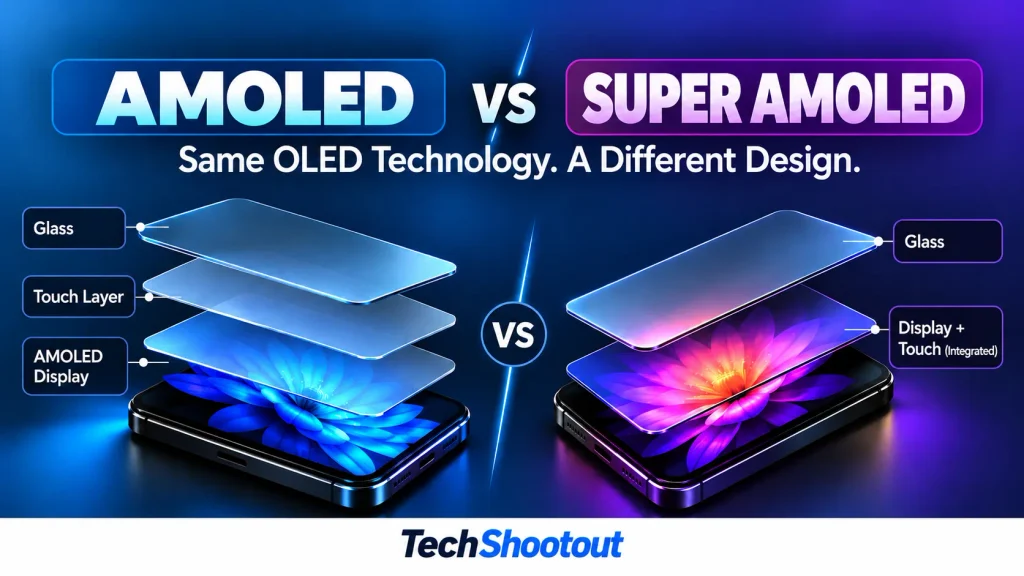
For smartphones, where manufacturers fight for fractions of a millimeter of internal space, reducing unnecessary display layers can be useful.
However, this distinction is much less useful for judging modern phones. Display construction has advanced considerably, and integrated touch technology is no longer enough on its own to identify the best screen.
Outdoor Visibility and Reflections
Super AMOLED has historically been promoted as providing improved outdoor visibility, partly because reducing layers between the OLED panel and the viewer can improve optical characteristics. The principle makes sense: every additional optical layer creates another opportunity for reflection and light loss.
But this is another area where the actual panel characteristics matter more than the AMOLED name today. Modern outdoor visibility depends heavily on factors including:
- Maximum and high-brightness-mode output
- Screen reflectivity
- Automatic brightness behavior
- Panel materials
- Polarizer technology
Samsung Display’s current OLED technologies have moved far beyond simply integrating touch. Newer panel developments focus on higher light transmission, lower reflections, and improved power efficiency. So if you’re comparing two current phones, don’t assume the Super AMOLED model will automatically be easier to see outdoors.
Look at measured brightness and real-world display testing instead.
AMOLED vs Super AMOLED Display Quality
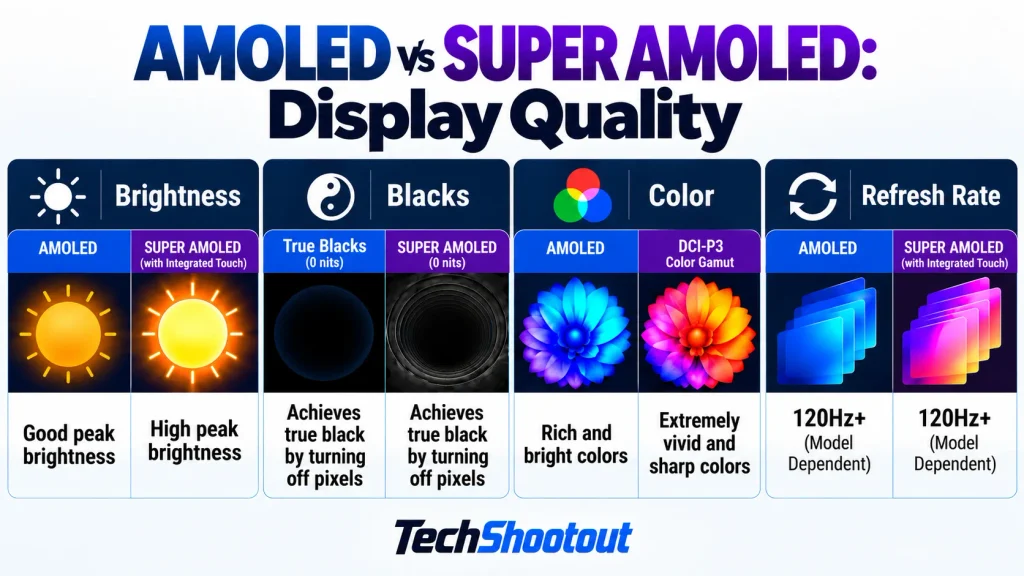
This is where the comparison becomes particularly interesting. Super AMOLED’s integrated construction brought meaningful technical advantages, but display quality cannot be determined from the AMOLED or Super AMOLED label alone.
Consider two hypothetical phones.
Phone A has a Super AMOLED display but is several years old, reaches relatively modest brightness, and runs at 60 Hz.
Phone B uses a newer AMOLED panel with substantially higher brightness, better color calibration, and an adaptive 120Hz refresh rate.
Phone B is likely to provide the better display experience despite lacking “Super” in its marketing name. Modern OLED performance increasingly depends on the technologies built around the underlying panel.
Brightness
Brightness has become one of the biggest differentiators between premium smartphone displays. A brighter display isn’t simply about producing a more impressive specification number. High brightness can make the phone considerably easier to use outside, particularly under direct sunlight.
It also matters for HDR content. Modern premium OLED panels can reach brightness levels that would have been remarkable when the Super AMOLED name first appeared. Samsung Display, for example, showcased next-generation OLED technology at Display Week 2026, capable of reaching up to 3,000 nits in High Brightness Mode.
That demonstrates just how far OLED development has moved beyond the original AMOLED vs Super-AMOLED distinction.
Contrast and Black Levels
Both technologies share the fundamental OLED advantage: individual pixels can effectively switch off when displaying black, producing extremely deep blacks and very high contrast.
Super AMOLED doesn’t fundamentally change this behavior. A standard AMOLED panel can also produce excellent blacks.
So if someone tells you that only Super AMOLED provides “true black,” that’s misleading. The underlying OLED nature of both technologies is responsible for this advantage.
Colors
AMOLED screens have long been associated with vivid, saturated colors. That can look impressive in a store, but more saturation doesn’t necessarily mean greater accuracy.
Modern smartphones often provide multiple display profiles, allowing manufacturers to offer a vivid presentation while also supporting more natural color reproduction. Color accuracy depends heavily on panel quality and calibration.
For that reason, we’d put far more weight on independent display measurements than the AMOLED terminology used on the specification sheet.
Refresh Rate
Refresh rate tells you how frequently the screen updates its image. A 120Hz display can make scrolling and animations appear noticeably smoother than a conventional 60Hz screen.
But refresh rate has nothing inherently to do with whether a display is called AMOLED or Super AMOLED. Both can support high refresh rates.
More advanced OLED panels can also dynamically adjust their refresh rate depending on what’s happening on screen, lowering it for static content and increasing it when smoother motion is needed. This can improve both smoothness and efficiency.
If choosing between two phones, refresh-rate capability and how intelligently the phone controls it are more useful specifications than the Super AMOLED label.
Does Super AMOLED Use Less Battery Than AMOLED?
This question doesn’t have a simple yes-or-no answer. Both AMOLED and Super AMOLED can be highly power efficient because individual OLED pixels emit their own light. This creates an interesting characteristic that what appears on the screen can affect power consumption.
A black OLED pixel can essentially switch off, while brighter pixels require energy to produce light. That’s why dark interfaces can reduce OLED display power consumption under the right conditions.
We noticed this effect when we tested Dark Mode battery consumption on an OLED iPhone 15, although the size of the saving depended heavily on what was displayed on the screen.
Super AMOLED’s integrated construction can improve light transmission by eliminating a separate touch layer, but that alone doesn’t guarantee lower display power consumption. Actual display power consumption depends on:
- Screen brightness
- Display size
- Resolution
- Refresh rate
- Panel generation
- Display driver
- Content being shown
- Adaptive refresh technology
- Software optimization
A newer AMOLED panel with more efficient materials and adaptive refresh could consume less power than an older Super AMOLED display.
And display efficiency is only one part of overall phone battery life. The processor, modem, battery capacity, software, and other hardware also affect how long a phone lasts between charges. This is why comparing battery life based solely on display branding is a mistake.
Is Super AMOLED Better in Sunlight?
Potentially, but not always. Super AMOLED’s integrated design can help with outdoor visibility because there are fewer layers between the display and your eyes. With the touch layer built directly into the display, there’s less material for light to pass through compared with designs that use a separate touch layer.
But that doesn’t mean a Super AMOLED screen will automatically be easier to see in sunlight.
Brightness and reflection handling matter just as much, and modern AMOLED panels have improved considerably in both areas. For example, an older Super AMOLED display that peaks at around 800 nits could look noticeably dimmer outdoors than a newer AMOLED panel capable of well over 1,000 nits with better reflection control.
So if outdoor visibility matters to you, don’t judge a phone by the Super AMOLED label alone. Look at its tested outdoor brightness and how well the screen handles reflections. Those figures will tell you much more about how the display actually performs in sunlight.
What About Burn-In?
Because both AMOLED and Super AMOLED belong to the OLED family, they share OLED’s potential for permanent image retention, commonly called burn-in.
Burn-in can occur when certain pixels age differently from others, particularly after displaying static elements for long periods. Think of interface elements such as navigation controls, game HUDs, logos, or other graphics that remain in the same position for extended periods.
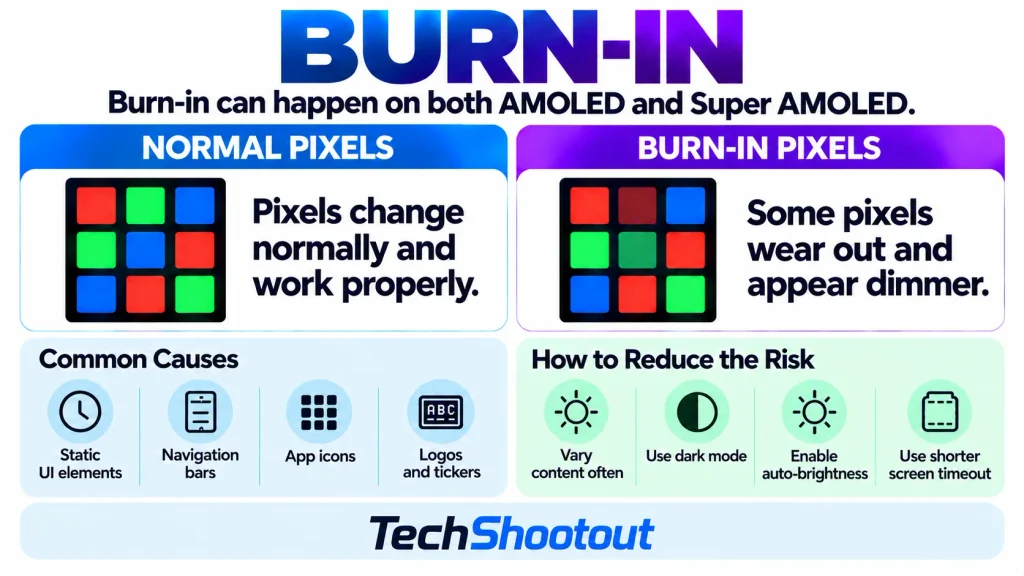
This isn’t a Super AMOLED-specific problem; it’s an OLED characteristic.
Modern OLED devices use display-management techniques intended to reduce the risk, although they cannot eliminate it entirely. Still, buyers who keep phones for many years should understand that the underlying risk hasn’t completely disappeared.
AMOLED vs Super AMOLED: Which Is Better?
If we compare the original technologies on equal terms, Super AMOLED has the more integrated design. Incorporating touch functionality into the display rather than relying on a separate touch film can produce a thinner structure and improve light transmission.
In that sense, Super AMOLED represents an improvement over older conventional AMOLED implementations. But that doesn’t mean Super AMOLED is always better than AMOLED.
Today, an AMOLED panel’s generation, brightness, refresh-rate technology, efficiency, resolution, and calibration can matter far more than whether Samsung attaches the “Super” label to it.
If you’re comparing two actual phones in 2026, we’d prioritize these factors:
- Brightness and outdoor readability
- Refresh rate and adaptive refresh capability
- Color accuracy
- Resolution and pixel density
- Power efficiency
- PWM behavior and eye comfort
- Overall panel generation and quality
Only after considering those would we put much weight on whether the marketing name says AMOLED or Super AMOLED.
AMOLED vs Super AMOLED: Which Should You Buy?
If you’re choosing between two smartphones and one says AMOLED while the other says Super AMOLED, don’t make your decision based on that difference alone.
Super AMOLED’s touch-integrated design is technically meaningful, and it represented an important step in smartphone OLED development. But display technology has advanced to the point where the branding tells you surprisingly little about the overall quality of a modern screen.
A newer, high-quality AMOLED panel can outperform an older or lower-spec Super AMOLED panel. The reverse can also be true.
Instead, compare the actual phones.
Look at brightness, refresh rate, resolution, efficiency, and professional display measurements. If possible, see both screens in person. Outdoor visibility and color tuning are particularly difficult to judge from a specifications table.
If you’re deciding between the two biggest smartphone brands, our iPhone vs Samsung comparison looks at displays alongside cameras, performance, battery life, software, and other differences.
Final Verdict
The AMOLED vs Super AMOLED debate is simpler than the names make it sound.
AMOLED is the broader display technology. Super AMOLED is Samsung’s AMOLED implementation historically distinguished by integrating touch functionality into the display panel, reducing the need for a separate touch-sensitive film.
That integration brings legitimate engineering benefits, including a thinner structure and improved light transmission. But deciding which is better, AMOLED or Super AMOLED, isn’t something you can do just from the name anymore.
If everything else were genuinely equal, we’d take the more integrated Super AMOLED implementation. In the real smartphone market, however, everything else is rarely equal. A modern AMOLED screen with higher brightness, better efficiency, adaptive refresh, and superior calibration can easily beat an older Super AMOLED panel.
Our advice: buy the better display, not the better-sounding display name.
FAQs
What is the main difference between AMOLED and Super AMOLED?
The main difference between AMOLED and Super AMOLED is how touch functionality is integrated. Super AMOLED was distinguished by integrating touch sensors into the display panel rather than relying on a separate touch-screen film. Both still use self-emissive OLED pixels controlled through an active-matrix system.
Is Super AMOLED better than AMOLED?
Technically, Super AMOLED’s integrated design offers advantages over older conventional AMOLED implementations. That said, not every AMOLED display is automatically inferior to a Super AMOLED display. Panel generation, brightness, refresh rate, efficiency, and calibration can matter far more to modern smartphone display quality.
Does Super AMOLED consume less battery?
Not necessarily. Both technologies can be power efficient, but actual consumption depends on brightness, content, refresh rate, panel generation, and other factors. A modern AMOLED panel can be more efficient than an older Super AMOLED panel.
Can AMOLED and Super AMOLED suffer from burn-in?
Yes. Both belong to the OLED family and therefore carry a risk of burn-in from prolonged or repeated static content. Modern display-management techniques can help reduce that risk.
Is Super AMOLED the same as OLED?
Super AMOLED belongs to the OLED family, but the terms aren’t interchangeable. OLED is the broader display technology. AMOLED is an active-matrix implementation of OLED, while Super AMOLED is Samsung’s AMOLED implementation, historically distinguished by integrating touch functionality more directly into the display.