
Table of Contents
Introduction
Battery life is probably the first thing you check before buying a new phone, even before the camera specs and chipset. A great camera and a powerful chip don’t count for much if you’re looking for a charger by the mid-afternoon. That’s why people keep asking the same question: does an iPhone battery last longer than a Samsung Galaxy phone?
Samsung usually focuses on bigger batteries and faster charging speeds. Apple, on the other hand, emphasizes efficiency, based on tight hardware and software integration to get more out of a smaller battery. But here’s the thing, if you’re only comparing battery capacity on a spec sheet, you’re not really getting the full story.
Phones today are way more complex than “bigger battery = better battery life.” Display technology, chip efficiency, how the software manages power, refresh rates, AI features running in the background, and how aggressively the system manages background apps when you’re not using them. Which is why you’ll sometimes see two phones with wildly different battery sizes end up lasting almost exactly the same in real-world use.
So in this comparison, we’ll look at everyday battery life, streaming, gaming, camera use, standby time, charging speeds, and how well each battery holds up over time. The goal isn’t simply to declare a winner but to help you decide which phone offers the better battery life experience for your needs.
Quick Comparison
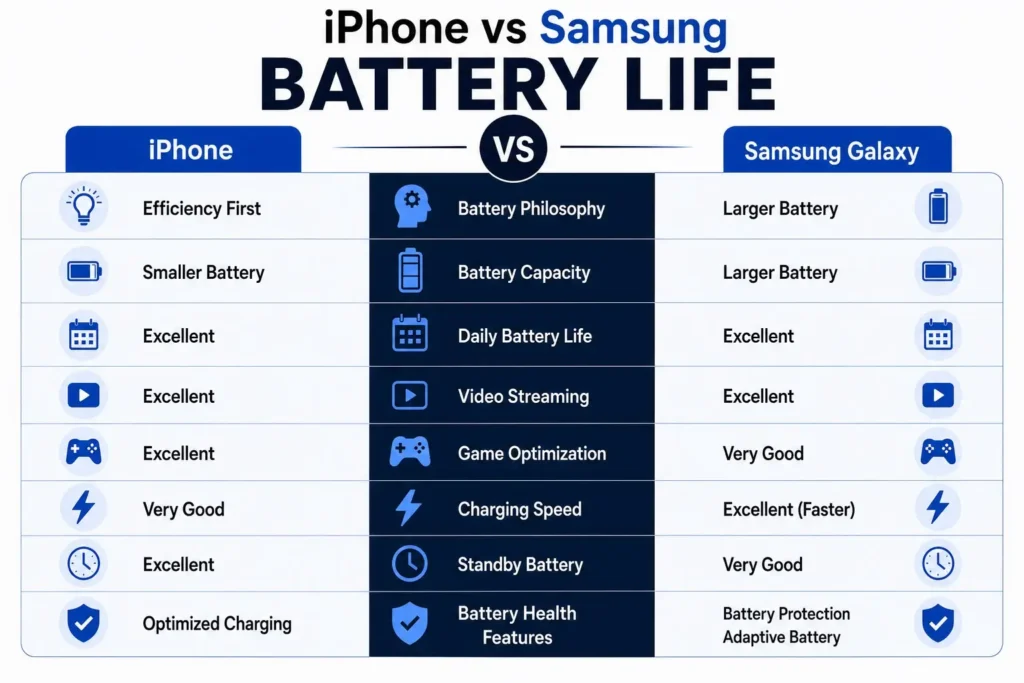
To make the iPhone vs Samsung battery life debate easier to understand, here’s a quick overview of how both brands approach battery performance.
| Feature | iPhone | Samsung Galaxy |
|---|---|---|
| Battery philosophy | Hardware and software efficiency | Larger batteries with smart power management |
| Battery Size | Smaller battery capacity | Usually around 5,000mAh |
| Everyday battery life | Excellent | Excellent |
| Video streaming | Excellent | Excellent |
| Gaming | Efficient performance | Often longer endurance due to larger batteries |
| Charging speed | Fast | Generally faster |
| Standby battery | Excellent | Very good to excellent |
| Battery health features | Battery Health, Optimized Battery Charging | Battery Protection, Adaptive Battery |
Key takeaway: A bigger battery doesn’t automatically mean longer battery life. Apple’s optimization lets iPhones keep pace with Samsung’s larger batteries, while Samsung pairs higher capacity with fast charging and smart power management.
Why a Bigger Battery Doesn’t Always Last Longer
A proper Samsung vs iPhone battery comparison goes beyond battery capacity, taking efficiency, software optimization, and real-world performance into account.
It’s tempting to assume the phone with the bigger battery wins. On paper, Samsung looks like the easy winner. Many Galaxy flagships come with 5,000mAh batteries, while recent iPhones rely on smaller ones. If battery capacity were the only factor, the iPhone vs Samsung battery life debate would’ve been settled years ago.
It isn’t that simple. Battery life comes down to how efficiently a phone uses the power it has, not just how much it can store. Chip design, display technology, software optimization, and background power management all play a role.
Battery Size Isn’t Everything
This is one of the reasons the iPhone vs Samsung battery life comparison often surprises people who expect larger batteries to automatically last longer.
Think of battery capacity (mAh) as the size of a car’s fuel tank. It tells you how much energy the battery can store. A bigger tank means more fuel, but not necessarily a longer trip. Fuel efficiency still matters.
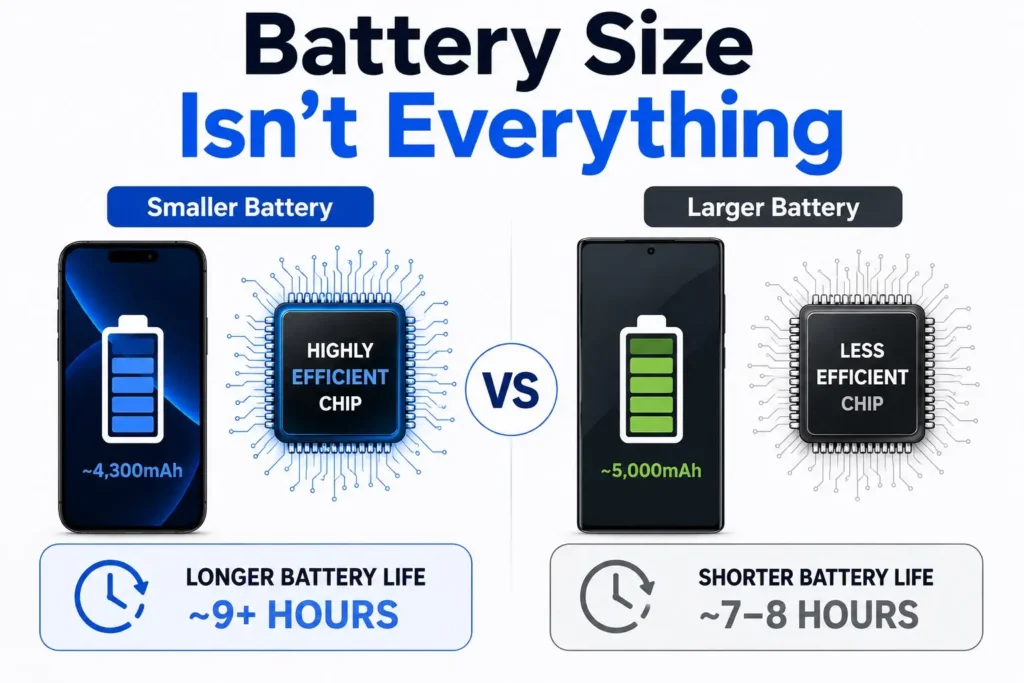
Phones work the same way. Samsung generally gives its Galaxy phones more capacity to work with. Apple relies on efficient chips and close hardware-software integration to use its battery more effectively. That’s how an iPhone with a smaller battery can often match or even outlast a Galaxy phone with a noticeably larger one.
Battery capacity is only part of the equation. How efficiently a phone uses its power has an even bigger impact on real-world battery life.
Why Processor Efficiency Matters
Better chip efficiency is closing the gap in the iPhone vs Samsung battery life comparison, even when one phone has a noticeably bigger battery than the other.
A big reason Apple’s phones perform well is chip efficiency. Since Apple builds both the processor and iOS, everything is designed to work together, which cuts down on wasted power during everyday tasks.
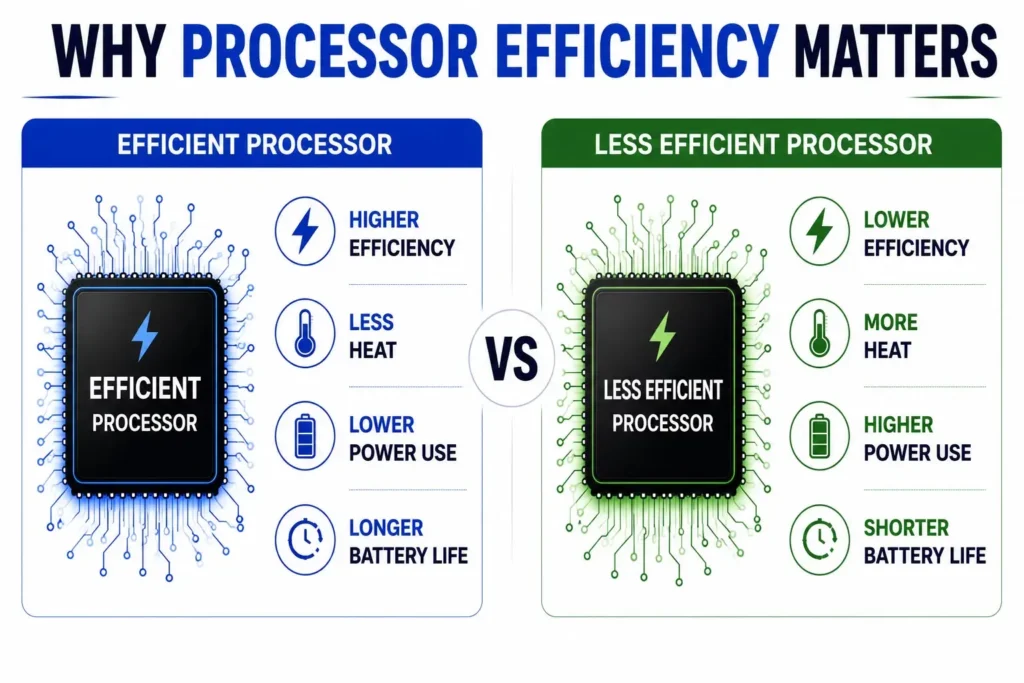
Samsung follows a different path. Galaxy phones run on Snapdragon or Exynos chips depending on region, and recent generations have gotten noticeably more efficient. Paired with larger batteries, this lets modern Galaxy phones deliver strong all-day battery life even under heavier use.
Both companies keep pushing chip efficiency forward, so today’s flagships are far ahead of models from just a few years back.
How the Display Affects Battery Life
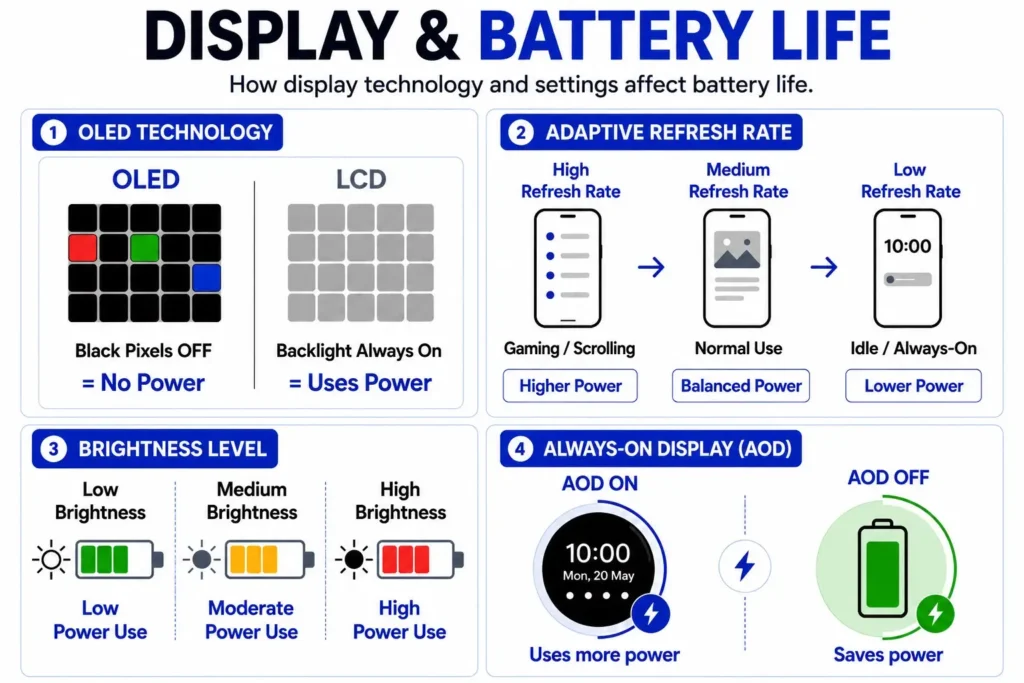
Display technology also plays a major role in the iPhone vs Samsung battery life comparison. It’s one of the biggest battery drains on any smartphone. The brighter the screen and the longer it’s on, the faster the battery will drop.
Apple and Samsung both use efficient OLED displays, and their adaptive refresh rate technology helps reduce power consumption by lowering the refresh rate when a higher one isn’t needed.
Apple explains how ProMotion dynamically adjusts refresh rates on supported iPhone models, while Samsung uses Adaptive Refresh Rate technology on many Galaxy devices.
In practice, there’s very little to separate the two. Screen brightness usually has a much bigger impact on battery life than the display itself, so lowering brightness or using Auto-Brightness often makes a more noticeable difference than the phone you choose.
The Role of Software Optimisation
Great hardware sets the stage, but it’s the software that decides how much you actually get out of it. In fact, software optimization is one of the main reasons iPhone and Samsung battery life can feel so different once you use the phones daily.
According to Apple’s official support documentation, it keeps things efficient by limiting background activity in iOS. Features like Background App Refresh, Low Power Mode, and Optimized Battery Charging all work together to cut battery drain without slowing things down.
Samsung does something similar with One UI. Samsung explains that Adaptive Battery learns which apps you actually use and prioritizes them while limiting activity from apps you rarely use. You can also manually restrict background activity or put apps to sleep yourself.
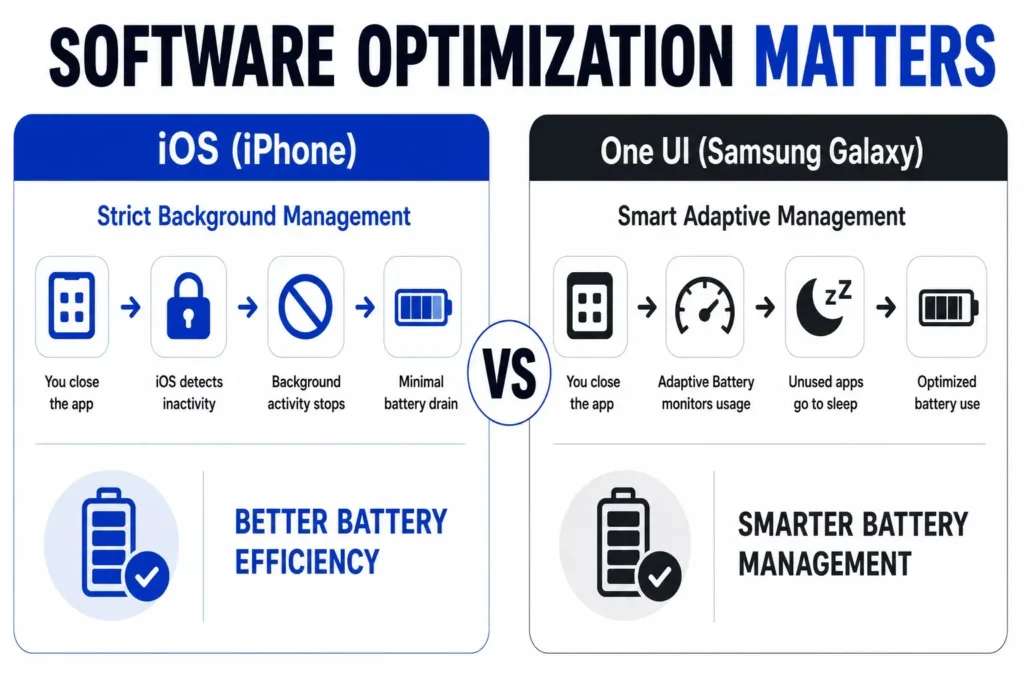
It’s one of the reasons iPhones and Galaxy phones often perform much more similarly in everyday use than their battery capacities would suggest.
Battery Life iPhone vs Samsung: Real-World Performance
When you compare iPhone vs Samsung battery life in real-world use, you get a much clearer picture than battery capacity alone can provide. Specifications are useful, but they only tell part of the story. Battery life depends just as much on how you use your phone.
Browsing, streaming, gaming, GPS, screen brightness, and background apps all make a difference, which is why two people using the same phone can finish the day with very different battery percentages.
That’s why real-world use matters more than battery capacity alone. The best way to judge battery life is to look at how a phone performs during the tasks you do every day, not just what’s printed on the specification sheet.
This is also why independent battery testing from reviewers such as GSMArena often provides a more useful comparison than battery capacity alone.
How Apple and Samsung Approach Battery Life
Apple and Samsung both deliver excellent battery life, but they achieve it differently. Apple gets the most from close hardware and software integration, while Samsung combines larger batteries with smart power management and faster charging. Both approaches deliver excellent battery life, even though they rely on different strengths.
How Apple Maximises Battery Efficiency
Apple’s whole strategy leans toward efficiency rather than a bigger battery. The custom chips, iOS, and hardware are engineered to work closely together, which helps keep power draw down during the everyday tasks people use their phones for most, like messaging and browsing.
On top of that, things like Optimized Battery Charging, Low Power Mode, and adaptive refresh rates chip in too, boosting both everyday battery life and how gracefully the battery ages over time.
How Samsung Balances Capacity and Performance
Samsung approaches battery life differently, leaning on bigger batteries paired with smart power management. Adaptive Battery, Power Saving Mode, and faster wired charging all come together to give Galaxy phones solid battery life, and that really shows during the more demanding stuff, like gaming, navigation, or recording video.
Real-World Battery Performance
Specs only tell part of the story. What matters most is how a phone performs in everyday use, like messaging, browsing, streaming, taking photos, using GPS, and the occasional gaming session. That’s what gives you a much clearer picture of iPhone vs Samsung battery life than comparing battery capacity alone.
Everyday Use
In daily use, iPhone vs Samsung battery life is reliable enough to get most people through a full day. Your usage habits often matter more than the brand.
iPhone
In everyday use, the iPhone delivers consistently reliable battery life. Email, Safari, social media, messaging, video calls, music, none of these are demanding, so Apple’s efficient chips barely break a sweat.
One of the iPhone’s real strengths is how well iOS handles background activity. Apps you’re not using consume very little power, and system processes are tuned to avoid unnecessary drain. As a result, battery levels often drop more gradually during typical everyday use.
Consistency is another plus, even after months of use, battery performance generally remains consistent. For most people, an iPhone gets through a full day of normal use without a second thought.
If your iPhone suddenly starts losing battery much faster than usual, our guide to fixing an overheating or slow iPhone explains the most common causes and practical fixes.
Samsung
Galaxy phones hold their own in everyday use too. Many flagship models pack larger batteries, giving you a bit more breathing room, it’s not unusual to end the day with charge to spare, even after heavy screen time.
A lot of that comes down to how One UI manages power behind the scenes. Adaptive Battery learns which apps you use most and limits background activity for the rest.
Samsung also hands you more control. Power Saving Mode, Sleeping Apps, and various performance settings let you decide how aggressively the phone should conserve battery when you need it to last.
For everyday stuff like messaging, browsing, and social media, the gap between an iPhone and a Galaxy phone is small enough that most people won’t notice.
Verdict
Both phones easily last a full day with typical use, and the difference is smaller than many people expect. The iPhone stands out for its consistent efficiency, while Samsung’s larger battery provides a little more breathing room during heavier days.
Video Streaming
For streaming, iPhone vs Samsung battery life remains highly competitive. Efficient displays and smart power management help both phones last longer.
iPhone
Streaming is probably the single thing most people do on their phones day in and day out, and the iPhone’s well suited for it. Apple’s OLED screens look excellent without using excessive power.
On models with adaptive refresh rate displays, the screen adjusts its refresh rate based on what’s on screen. Since videos play at a fixed frame rate, the display doesn’t need to refresh as often as it would while scrolling or gaming.
Apple also uses dedicated hardware to decode video efficiently, reducing the workload on the main processor. In practice, that means you can settle in and watch for hours without having to think about the battery.
Samsung
Samsung’s been putting out some of the best displays in the business for years now, and that experience carries over to video playback.
Their Dynamic AMOLED panels deliver rich colors and deep blacks without putting a heavy drain on the battery, and combined with the larger batteries found in most Galaxy phones, long streaming sessions aren’t really a problem.
Adaptive refresh rate helps here too as well, dialing back whenever the phone doesn’t need to push a higher rate. In everyday use, there’s very little to separate the two. Heavy streamers are likely to be happy with either phone.
Verdict
Streaming performance is excellent on both platforms. Unless you watch videos for hours every day, you’re unlikely to notice a meaningful battery life difference between an iPhone and a Galaxy phone.
Gaming Performance
Gaming is one of the toughest tests for iPhone vs Samsung battery life. Larger batteries and efficient chips both play an important role.
iPhone
Gaming is a completely different workload from browsing or streaming. The processor, graphics chip, display, and cooling system are all working much harder, so battery drain is naturally much higher.
Apple’s custom chips are up to the task, though. They deliver strong gaming performance while remaining surprisingly efficient, even in demanding titles. Apple also manages heat well during longer sessions too, so performance stays consistent instead of tapering off.
You’ll notice the biggest battery drain in games that keep the display running at high refresh rates while pushing the GPU aggressively. For casual games, battery drain is generally modest. Even if you’re putting in serious hours, you can usually expect several hours of play before you’re reaching for a charger.
Samsung
Galaxy phones hold their own for gaming too, and the bigger batteries genuinely pay off during longer, more demanding sessions. Most flagship models also have capable cooling systems, helping maintain steady performance over extended play.
Samsung also gives gamers a bit more control. Game Booster lets you balance performance and battery life depending on what matters more for the game you’re playing. You’ll notice the biggest battery drain in games that keep the display running at high refresh rates while pushing the GPU hard.
For anyone gaming several hours a day, the combination of a bigger battery, fast charging, and gaming-focused software gives Samsung a slight edge, but it’s not a huge one, since Apple’s chips remain exceptionally efficient.
Verdict
Samsung has a slight advantage for long gaming sessions thanks to its larger battery and faster charging. However, Apple’s highly efficient chips keep battery drain surprisingly low, making both phones strong choices for mobile gaming. Depending on the models being compared, either phone may last longer in independent battery tests.
Camera Usage and Video Recording
When comparing iPhone vs Samsung battery life during camera use, both phones perform well, although Samsung’s larger battery can provide a little more recording time.
iPhone
The camera is probably the most-used feature on any phone, and it’s also one of the biggest battery drains. High-resolution photos, 4K video, Portrait mode, and Cinematic mode all demand significant processing power.
Apple has spent years balancing camera performance with battery life. Every photo goes through HDR, noise reduction, and image enhancement, but the close integration between Apple’s chips and iOS keeps battery drain surprisingly low.
Casual photography has little impact on battery life, even if you take dozens of photos. Recording 4K video is more demanding, but battery life remains manageable unless you’re filming for extended periods.
Samsung
Galaxy phones are every bit as capable here too, and the larger battery genuinely earns its keep during long camera sessions, especially if you’re recording lots of video or taking hundreds of photos in a day.
Modern Galaxy phones use AI to improve color, detail, and low-light performance, which requires additional processing power. The higher-capacity battery helps offset that extra power use, so the impact on battery life is usually less noticeable.
Recording 4K or 8K video naturally drains the battery faster, but Samsung’s larger batteries and faster charging make extended recording sessions easier to manage.
That extra battery capacity is especially useful for vloggers and travelers who spend long periods away from chargers. For everyday photography, though, there’s very little to separate an iPhone from a Galaxy phone.
Verdict
Both phones handle photography without major battery concerns. Samsung’s larger battery is more noticeable during extended 4K or 8K recording, while the iPhone remains highly efficient for everyday photo and video use.
Standby Battery Life
Standby performance is another area where the iPhone vs Samsung battery life comparison becomes surprisingly close on modern flagship phones.
iPhone
Battery performance isn’t just about how long the screen stays on. Standby drain matters just as much, especially for anyone who isn’t checking their phone every five minutes.
Apple takes a very conservative approach to background activity. iOS keeps a tight grip on background activity, so apps sitting idle have very little impact on battery life.
Leave an iPhone unplugged overnight, and it’s common to lose only a few percentage points of battery. That means you’re more likely to start the next day with plenty of charge left.
Samsung
Samsung has made real strides here as well. Older Galaxy phones used to struggle a bit with idle drain, but One UI has closed a lot of that gap over the years.
Adaptive Battery gradually adapts to your usage, limiting background activity for apps you rarely use, and if you want to get hands-on, you can put apps to sleep or restrict processes yourself.
Standby drain still varies depending on what’s switched on, like Always-On Display, constant location tracking, wearable syncing, and cloud backups, which can all increase standby battery drain.
But Samsung also gives you more control over what stays active in the background. The iPhone still edges it out slightly on raw idle efficiency, but that gap’s a lot smaller than it used to be just a few years back.
Verdict
Modern Galaxy phones have greatly improved standby performance, but the iPhone still holds a small edge in idle efficiency. For most users, the difference is minor in day-to-day use.
Charging Speed and Long-Term Battery Health
Apple and Samsung have different priorities here as well. Samsung leans into speed and convenience, while Apple plays the long game, prioritizing longevity and steady performance over time.
Charging Speed:
Charging speed also plays an important role in the overall iPhone vs Samsung battery life experience, especially for people who recharge throughout the day.
iPhone
Apple approaches charging differently. Rather than chasing the fastest charging speeds, it focuses on balancing convenience with long-term battery health. Optimized Battery Charging learns your routine and reduces the amount of time the battery spends at 100%, helping to minimize long-term wear.
iPhones aren’t the quickest to recharge compared with many flagship Android phones, but they’re fast enough for everyday use. In return, Apple prioritizes battery longevity, helping maintain consistent performance over the years.
Samsung
By contrast, Samsung prioritizes speed and convenience. A lot of Galaxy flagships support noticeably faster wired charging, so you can go from low battery to a solid charge much more quickly than an iPhone.
Samsung also supports fast wireless charging and Wireless PowerShare, and you’ve got a phone that’s well suited for anyone who’s topping up throughout the day rather than just once at night.
If your Galaxy phone suddenly starts charging much more slowly than expected, our guide on fixing Samsung fast charging issues covers the most common reasons and fixes to solve the problem.
Verdict
Samsung is the better choice if fast top-ups matter most, offering noticeably quicker charging. Apple trades charging speed for long-term battery care, prioritizing battery health over outright speed.
Which Battery Lasts Longer Over Time?
If you’re wondering does iPhone battery last longer than Samsung over several years, battery care and charging habits make a significant difference. Long-term battery life isn’t decided by the brand alone. How you charge and use your phone plays just as big a role.
Every lithium-ion battery loses some capacity over time. Battery University, an independent educational resource on battery technology, provides a detailed explanation of how lithium-ion batteries age and what users can do to slow the process. Charging habits, heat, and the software managing the battery all influence how quickly that wear becomes noticeable.
Apple includes a built-in Battery Health feature that shows your battery’s maximum capacity, while Optimized Battery Charging learns your charging routine to help reduce long-term wear. Samsung offers Battery Protection, which can limit charging to around 80%, along with temperature management designed to reduce stress during charging.
No matter which phone you choose, a few simple habits can help keep your battery healthier for longer:
- Avoid exposing your phone to excessive heat.
- Use high-quality, certified chargers.
- Keep your software up to date.
- Avoid leaving the battery completely drained for long periods.
- Enable battery protection features, such as Optimized Battery Charging or Battery Protection, when they’re available.
Verdict
Neither brand has a clear long-term advantage. With built-in battery protection features and good charging habits, both iPhones and Galaxy phones can maintain strong battery performance for years.
Which Phone Should You Buy?
This Samsung vs iPhone battery comparison shows that both brands excel, but each appeals to different types of users.
Go with an iPhone if you care about efficient power management, consistent battery performance, strong standby time, and a battery that holds up well over the years. It’s also the better fit if you already use an Apple Watch, Mac, or iPad.
If you’re already using several Apple devices, our guide to the Apple ecosystem explains how features like Handoff, AirDrop, and Continuity work together to create a seamless experience.
Choose a Samsung Galaxy phone if you want a higher-capacity battery, faster charging, and more control over battery settings. That extra capacity becomes most noticeable if you spend hours gaming, record lots of video, or regularly go long periods without access to a charger.
If you already own other Galaxy devices, our guide to the Samsung ecosystem explores how Galaxy phones, tablets, watches, and earbuds work together to create a more connected experience.
Neither phone is the outright winner. Flagship iPhones and Galaxy phones both deliver battery life that’s good enough to get most people comfortably through a full day. The better choice depends on how you use your phone and which ecosystem fits your needs best.
Final Thoughts
There’s no single winner when it comes to iPhone vs Samsung battery life. Apple’s strategy is getting the most out of a smaller battery through close hardware and software integration. Samsung leans in the opposite direction, pairing larger batteries with faster charging and more control over power management.
In day-to-day use, though, the gap is much smaller than many people expect. Whether you’re browsing, streaming, gaming, taking photos, or using GPS, today’s flagship iPhones and Galaxy phones will comfortably last through a full day for most people.
If efficient power management, strong standby time, and long-term battery health matter most, an iPhone is a great choice. If you’d rather have a larger battery, faster charging, and more control over battery settings, a Galaxy phone is likely to suit you better.
Battery capacity shouldn’t be the only thing driving your decision. Performance, camera quality, software, long-term support, and the ecosystem you’re already invested in all matter just as much. Battery life is only one part of the overall experience.
So when someone asks which phone has better battery life, an iPhone or Samsung, there’s really no clear answer. The better choice depends on how you use your phone and what matters most to you.
FAQs
Which phone has better battery life, iPhone or Samsung?
Both brands offer excellent battery life. iPhones rely on hardware and software optimization, while Samsung phones typically combine larger batteries with efficient power management and faster charging.
Is iPhone vs Samsung battery life different in everyday use?
The iPhone vs Samsung battery life difference is usually small during normal activities like browsing, messaging, streaming, and social media. Heavy gaming or extended camera use may produce more noticeable differences.
Why do Samsung phones have larger batteries than iPhones?
Samsung generally uses higher-capacity batteries to support larger displays and more customizable features, while Apple focuses on improving efficiency through its chips and iOS optimization.
Does battery capacity determine which phone has better battery life?
No. Battery capacity is only one factor. Processor efficiency, display technology, software optimization, and background app management all affect overall battery performance.
Which is better for gaming, iPhone or Samsung?
Both perform well for gaming. Samsung’s larger batteries can provide longer gaming sessions, while Apple’s efficient processors help reduce battery drain and maintain consistent performance.
Which phone charges faster, iPhone or Samsung?
Samsung generally offers faster wired charging than the iPhone. Apple focuses more on battery longevity and optimized charging to help preserve long-term battery health.
Should battery life be the deciding factor when buying a phone?
Battery life is important, but it shouldn’t be the only factor. Consider camera quality, software experience, ecosystem, performance, update support, and charging features before deciding which phone best meets your needs.