
Table of Contents
Introduction
AI in smartphones is reshaping modern phones faster than any single hardware upgrade has in years. Cameras, processors, and batteries still matter, but AI is now one of the biggest factors shaping how modern phones behave day to day.
AI-powered smartphones now do much more than make calls and send texts. They take better photos, translate on the fly, block spam calls, manage your schedule, and help you write. Most of this runs quietly in the background, so the phone just feels smarter without you noticing the machinery behind it.
Old software just follows instructions. But AI works differently; it watches how you use your phone and changes its behavior accordingly. Most modern phones now come with an NPU (Neural Processing Unit), a chip that does a lot of AI work locally on the device instead of sending it off to the cloud.
That’s what makes things faster, keeps your data more private, and lets certain features work even without an internet connection. Major smartphone makers, including Apple (Apple Intelligence), Google (Google AI), and Samsung (Galaxy AI), have increasingly shifted AI processing onto devices to improve privacy, reduce latency, and enable offline features.
This guide looks at how AI in smartphones is changing modern phones, the technology behind it, what it is actually good for, where it still falls short and where things might be headed next.
What Is AI in Smartphones?
AI in smartphones basically means machine learning and specialized hardware working together so the phone can handle tasks that normally require human decision-making. Instead of running on fixed code, these systems learn from data and improve over time.
Most modern phones now pack a Neural Processing Unit (NPU) alongside the usual CPU and GPU. The CPU handles general computing, the GPU takes care of graphics, and the NPU is built specifically to crunch AI workloads. The NPU does heavy calculations fast while using very little power. That’s a big reason so many AI features now run directly on the phone instead of being shipped off to a server somewhere.
Face unlock, predictive text, scene detection in your camera, voice assistants, battery tuning, live translation, spam filtering, and smart search are powered by AI. Older phones just executed commands. These ones actually pick up on your patterns and routines and adjust accordingly.
How On-Device AI Works
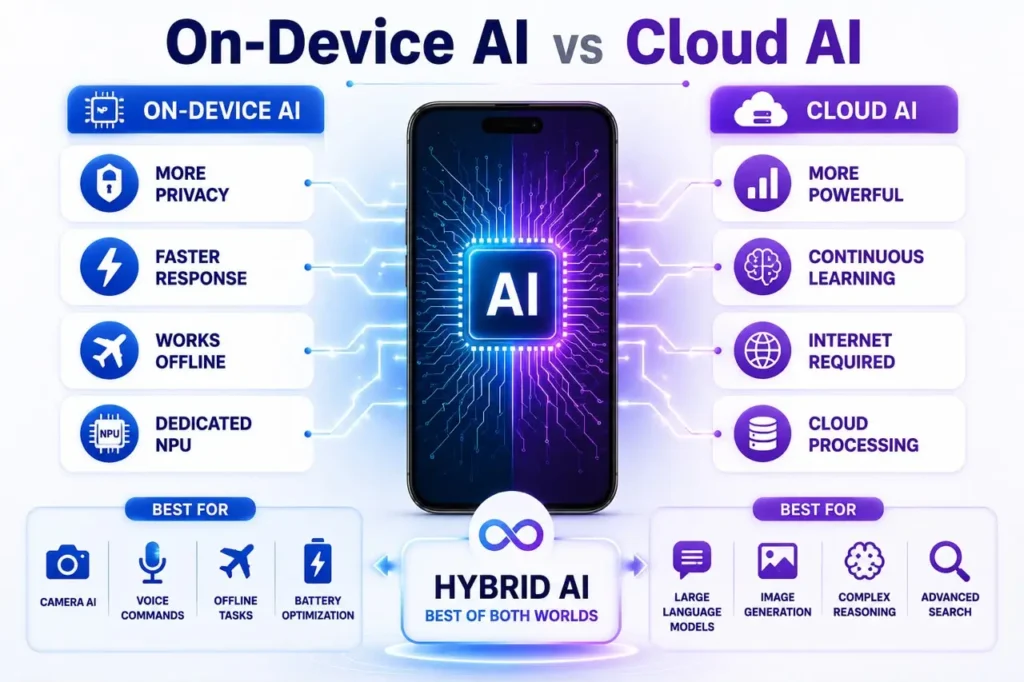
One of the biggest advances in AI in smartphones is the rise of on-device AI. Instead of sending every request off to a cloud server, a lot of AI tasks now run right on the phone itself. Voice dictation, photo touch-ups, writing help, and translation often run locally using the NPU. That reduces waiting time and keeps things working even without an internet connection.
One of the biggest benefits of on-device AI in smartphones is improved privacy because more data stays on the device. Your photos, voice clips, and documents just stay on your phone instead of being sent to a server every time you use a feature. Cloud AI still has an important role to play. More demanding tasks, such as generating images or running large AI models, are usually processed in the cloud because they require far more computing power than a smartphone can provide.
So most phones run on a hybrid setup these days. Simple tasks stay local for speed and privacy, the more demanding tasks go to the cloud. It’s a practical balance between performance and capability. As chipsets become more powerful, on-device AI in smartphones will continue replacing cloud processing for everyday tasks.
If you want to understand this topic in more detail, read our complete guide: Why On-Device AI Is Replacing Cloud AI.
How AI Is Improving Smartphones
AI in smartphones now plays a role in almost every part of using a phone, from photography to battery life and security. A lot of these features work behind the scenes, built into the OS and your everyday apps rather than a separate AI app.
Smarter Photography
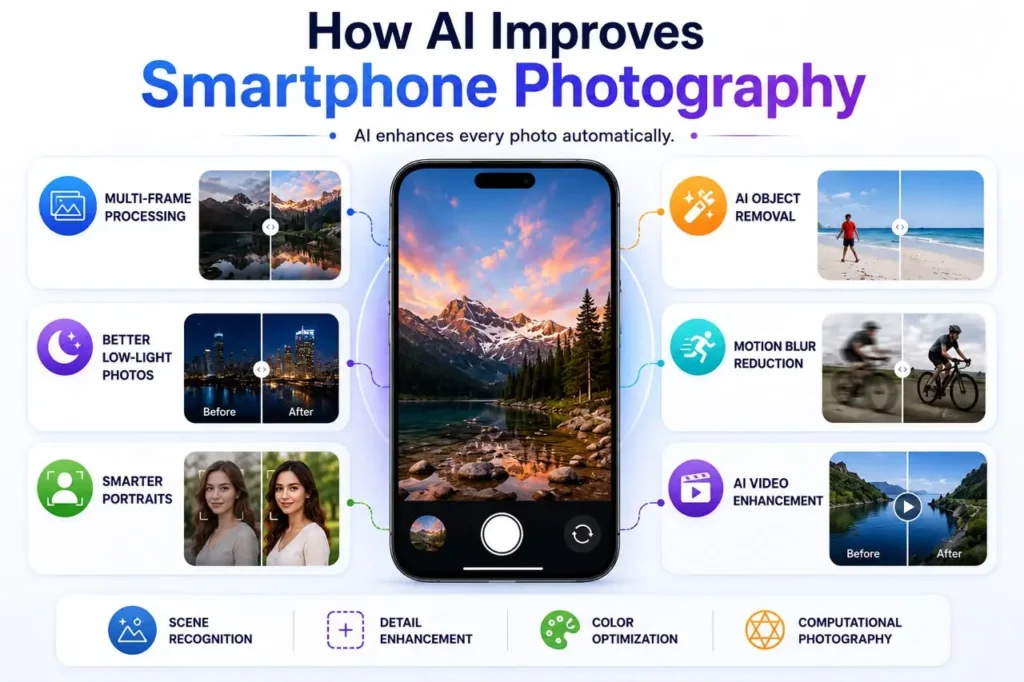
Photography is one of the biggest examples of how AI in smartphones improves the overall user experience. Camera hardware has advanced significantly, but software plays an equally important role in determining image quality today. When you press the shutter, your phone typically captures multiple frames in a fraction of a second. AI then reduces noise, balances exposure, sharpens detail, and merges everything into one photo instantly. That’s computational photography.
It can also recognize what you’re shooting, a sunset, a plate of food, a document, or a portrait and adjust brightness, contrast, and color to match. Portrait mode has gotten noticeably better too. AI separates the subject from the background with real precision, producing a depth effect that used to require a proper camera.
Beyond that, AI now handles low-light shots, removes unwanted objects, reduces motion blur, stabilizes video, and can even touch up a photo after it’s been taken.
Smarter Video Recording
AI is improving video as well. Phones use AI to stabilize shaky footage, adjust exposure mid-recording, cut background noise, and keep moving subjects in focus. Some can boost HDR in real time or adapt settings as lighting changes.
AI editing tools are showing up more often as well, removing objects, cleaning up audio, generating highlight clips, and applying automatic edits without editing skill required.
More Natural Conversations
Voice assistants used to need exact commands and struggled with anything conversational. Now they handle natural speech and understand context much better.
This is another area where AI in smartphones has improved significantly over the past few years. Phones can answer questions, set reminders, summarize your messages, control smart home gear, translate conversations, and draft emails. Recent AI assistants like Siri in Apple also understand conversational context much better than earlier voice assistants by combining large language models with on-device processing for supported tasks.
Some even remember earlier conversations, which makes the whole thing feel less robotic. A lot of these functions now run offline too, which means faster responses and less of your data leaving the device.
AI Agents
The next step is AI agents. Assistants that handle several tasks from one request instead of one command at a time. Ask your phone to summarize a meeting, build a to-do list, set reminders, and draft a follow-up email, and it can chain all of that together instead of you switching between apps. If you are interested in knowing how these features work, check out our detailed guides, Galaxy AI Explained and Apple Intelligence Explained.
As AI in smartphones continues to evolve, these assistants will become even more capable of handling everyday tasks automatically. Major technology companies are developing AI agents that can complete multiple related tasks from a single request. While these capabilities are still evolving, they point toward smartphones becoming more proactive over the next few years.
Battery Life and Performance
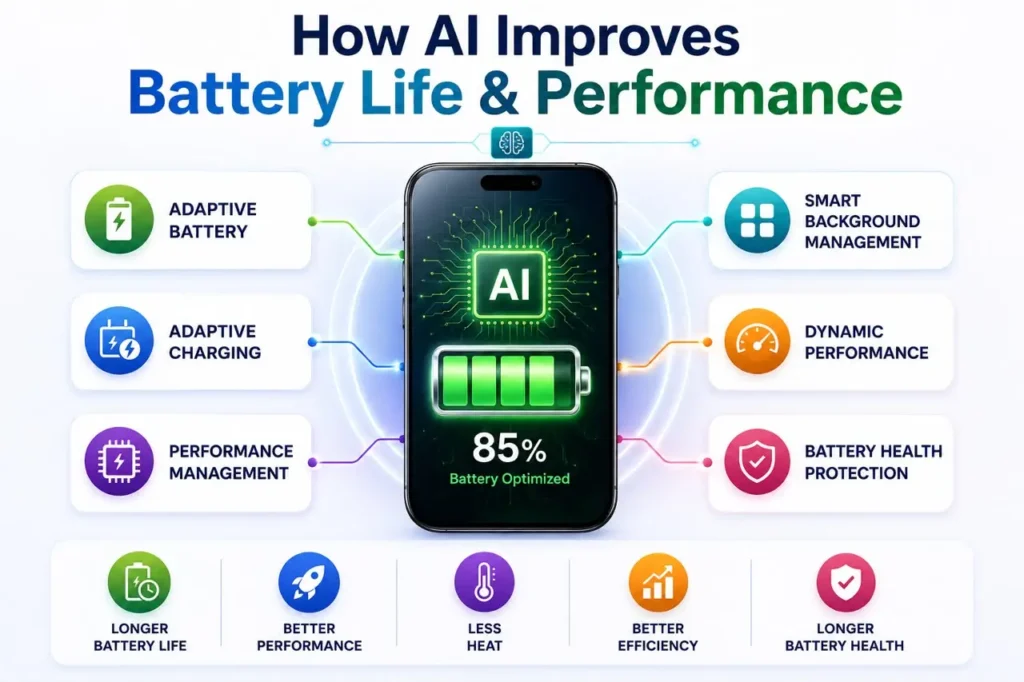
AI in smartphones isn’t just adding new features to your phone. It’s quietly making the whole experience faster, smoother, and more efficient behind the scenes. It pays attention to how you actually use your apps, which ones you open constantly, which ones you forgot you even installed, and what times of day you usually use them.
For example, Android’s Adaptive Battery also learns which apps you use most often and limits background activity for less frequently used apps to help extend battery life.
Charging has gotten a lot smarter too. Adaptive charging figures out your daily routine, so if you usually pick your phone around 7am, it might stop charging at 80% overnight and finish charging just before you wake up. Small optimizations like these can help keep your battery healthy for longer.
It’s also constantly adjusting how much power the processor uses. Gaming or editing video? It increases the performance. Just checking messages? It reduces performance to save battery life. All of this helps your phone run smoothly while using less power.
Privacy and Security
Security has also improved. Facial recognition and fingerprint scanning now use AI to verify it’s really you, and they’re smart about it, analyzing depth and facial structure so you’re still recognized even if your look changes a little, like a new haircut or a pair of glasses.
AI also flags suspicious apps, filters spam calls and texts, and warns you before you land on a suspicious website, mostly running quietly in the background without slowing the phone down. And since more of this processing happens on-device, your sensitive data stays more private. This is one of the biggest advantages of modern AI in smartphones.
Android devices use technologies such as Google Play Protect to scan apps for potentially harmful behavior, while Apple combines on-device processing with privacy-focused security features for supported AI experiences.
Everyday AI Features
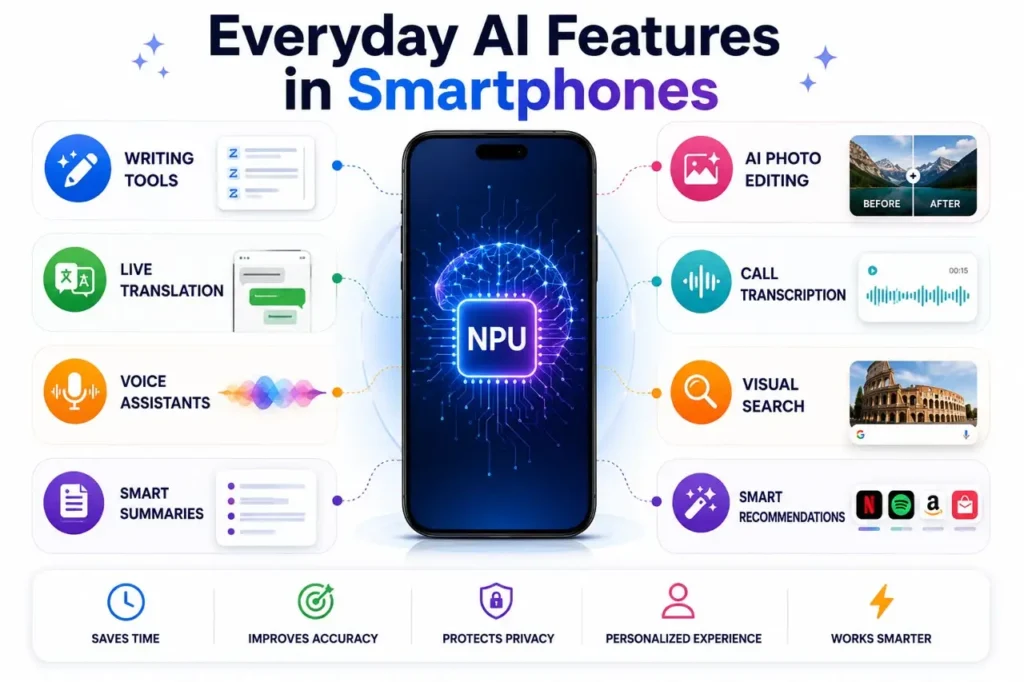
The benefits of AI in smartphones go beyond photography and include battery optimization, security, and accessibility. It’s found across everything from messaging to accessibility to search to content creation. It’s not an extra app; it’s built into the OS, so it feels like part of the phone.
Language Translation
Phones can now translate conversations, messages, and live speech in real time. That’s a big advantage for travelers, students, and anyone working across languages: no need for a separate translation device, just speak into the phone. A lot of this works offline too, which matters when you’re traveling or stuck with a weak signal.
Typing has gotten smarter as well. Keyboards predict words, fix grammar, suggest better phrasing, and generate replies based on context, helping you type faster with fewer mistakes.
Generative AI
Generative AI is becoming one of the fastest-growing areas of AI in smartphones. Generative AI doesn’t just recognize information, it creates new content. You can summarize articles, rewrite emails, explore ideas, build shopping lists, generate images, edit photos, or draft documents straight from your phone. Apple’s Writing Tools, Google’s Gemini, and Samsung’s Galaxy AI already bring many of these generative AI features directly to supported smartphones.
Instead of switching between apps, a lot of this now happens in one conversation with an assistant, saving time for both work and everyday tasks. As phone processors get more powerful, more of this is running locally, giving faster responses, and your data stays more private. These improvements show how AI in smartphones benefits a much wider range of users.
Visual Search
Search is becoming more visual. Instead of typing a question, you can point your camera at an object, product, landmark, or block of text and get an answer almost instantly.
Tools like Circle to Search let you identify objects, pull text from images, translate signs, solve math problems, and search the web, all without leaving the app you’re in. You’re showing the phone what you mean instead of describing it.
Accessibility
AI is also making phones a lot more usable for people with different needs. Live captions automatically show subtitles for videos and calls. Screen readers describe what’s in images and read text out loud. Voice control lets you run the whole phone hands-free. What’s interesting is a lot of these features didn’t stay accessibility-only. Captions, voice typing, and text recognition have become everyday tools everyone uses.
Phone Calls
Calls are getting smarter too. AI reduces background noise so voices come through clearer in noisy places, and it flags spam calls before they interrupt you. Some flagship phones support live call translation, so two people speaking different languages can actually talk to each other. Others generate transcripts or summaries after the call ends, making it easier to recall details later.
Challenges of AI in Smartphones
While AI in smartphones brings many benefits, it still comes with several challenges. Manufacturers keep working on these, but there are real limitations worth knowing about.
Privacy Concerns
Privacy is still a significant concern. Sure, more processing happens right on your device now, but plenty of requests still get shipped off to the cloud. People deserve to know what data’s being collected, how it’s actually being processed, and whether it’s being stored securely.
Apple, Google, and Samsung are all investing heavily in on-device AI processing to reduce the amount of personal information that needs to leave a user’s device, although some advanced AI features still rely on cloud processing. But honestly, it’s still a work in progress, not a solved problem.
Battery Consumption
Heavy AI tasks like image generation, live translation, and real-time video can drain your battery fast, especially during long sessions. Chipmakers keep building more efficient processors and NPUs, but balancing AI power with battery life is still a challenge. Companies such as Qualcomm, MediaTek, and Apple continue improving AI accelerators to deliver higher performance while reducing power consumption.
Hardware Limitations
Not every phone can run the latest AI features. They need real processing power, dedicated NPUs, and extra memory. That’s why manufacturers launch them on flagships first, then slowly bring them to mid-range and budget phones. Even older phones with the newest software updates can miss out, just because their hardware isn’t built for it. Better hardware will continue to expand what AI in smartphones can do in the coming years.
AI Isn’t Always Accurate
AI still isn’t perfect. It can provide incorrect answers, misunderstand your questions, or summarize information inaccurately, and AI image tools can also produce misleading or inaccurate results. Even leading AI developers such as OpenAI acknowledge that generative AI systems can occasionally produce inaccurate or misleading responses, making human verification important for important decisions.
Think of it as a helpful assistant rather than a replacement for your own judgment. If something is important, it’s always worth double-checking before relying on it.
The Future of AI Smartphones
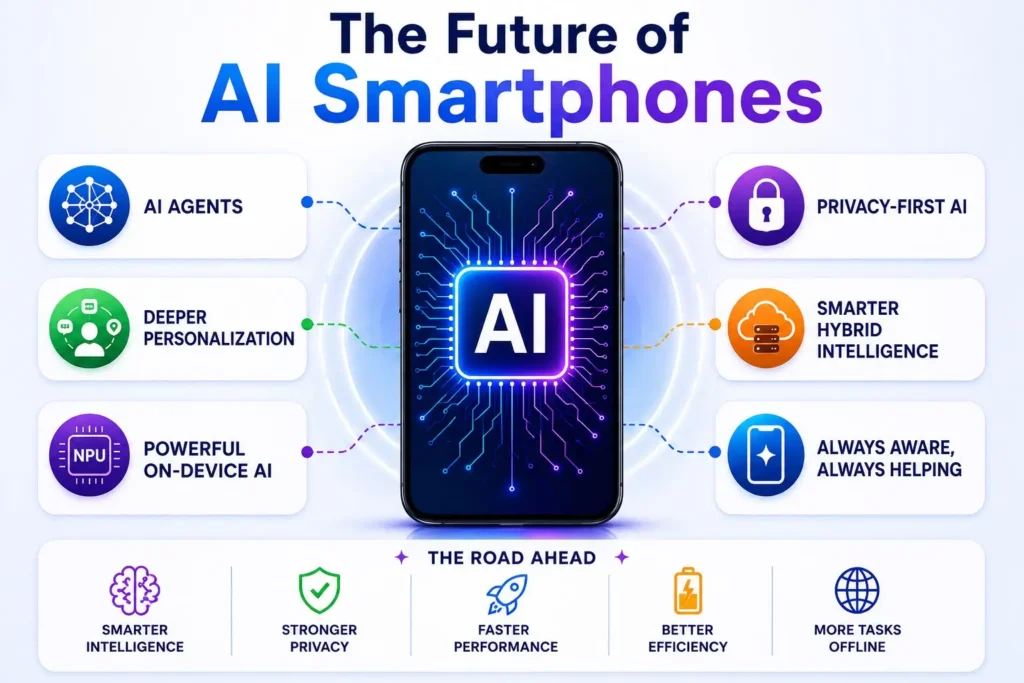
The future of AI smartphones is evolving quickly as mobile processors become more capable. Future phones won’t just wait for instructions. They’ll better understand what you’re trying to do, anticipate your needs, and handle more tasks with minimal input.
More Personal AI
Phones already learn your habits, but future AI is set to take that personalization even further; instead of waiting for you to open an app, it might act on its own by reminding you to leave early due to traffic, accessing your travel details from a confirmation email, or preparing a meeting summary before you even think to ask. As it gets smarter about context, your phone starts feeling less like a tool you operate and more like an assistant that genuinely helps run your day.
Faster On-Device AI
One of the bigger trends right now is the continued focus on on-device AI. As NPUs keep getting more powerful, phones will be able to handle more complex AI tasks without depending on cloud processing, which means faster responses, better privacy, and more features that work even without an internet connection. Cloud AI isn’t going anywhere, but AI in smartphones will rely much more on on-device processing for everyday tasks.
Final Thoughts
AI is one of the biggest forces shaping today’s smartphones. It changes the way we use our phones every day, from better photography and smarter voice assistants to adaptive charging, stronger security, live translation, and generative AI. Most of this continues in the background, learning how you use your device, making performance better, and automatically dealing with routine tasks.
The future of AI in smartphones looks increasingly focused on faster on-device processing, stronger privacy, and smarter everyday experiences. As the mobile chips improve, more AI features are expected to run directly on the device. There are still challenges to work through, privacy concerns, hardware limitations, and the occasional inaccuracy.
FAQs
What is AI in smartphones?
AI in smartphones runs on machine learning combined with dedicated hardware, such as a Neural Processing Unit (NPU). These enable things like photo enhancement, language translation, speech recognition, battery management, and personalization of your experience. A lot of this increasingly happens right on the device, giving you faster performance and better privacy.
How does AI improve smartphone performance?
AI improves smartphone performance by learning how you use your device. It can prioritize frequently used apps, reduce background activity, optimize processor performance, and manage power consumption to make the phone faster and extend battery life.
What is on-device AI in smartphones?
On-device AI means AI tasks are processed directly on your phone instead of being sent to cloud servers. This approach provides faster responses, works even without an internet connection for many features, and helps keep personal data more private.
What are the most useful AI smartphone features?
Some of the most useful AI smartphone features include computational photography, live language translation, spam call detection, adaptive battery charging, AI writing tools, voice assistants, visual search, photo editing, and real-time transcription.
Do AI features drain smartphone battery life?
Some demanding AI features, such as image generation, live translation, and video enhancement, can use more battery. However, AI also helps optimize overall power consumption through adaptive charging, app management, and intelligent performance adjustments.
Is AI in smartphones safe for privacy?
Modern smartphones increasingly process AI tasks on the device, which helps protect user privacy. However, some advanced features still rely on cloud processing, so it’s important to review your device’s privacy settings and understand how your data is handled.
Do all smartphones support AI features?
No. Most smartphones offer some AI capabilities, but advanced features often require newer processors with dedicated NPUs and sufficient memory. As a result, flagship devices typically receive the latest AI features before mid-range and budget models.
What is the future of AI in smartphones?
The future of AI in smartphones is expected to focus on more powerful on-device processing, smarter AI assistants, improved personalization, better privacy, and AI agents capable of handling multiple tasks automatically with minimal user input.